Stralsund 1665: The Aerial Battle Explained
In 1665, six fishermen saw warships battling in the sky over Stralsund. Modern research by Staatliche Museen zu Berlin identifies this as a Fata Morgana mirage of a real naval battle beyond the horizon.

Support Independent UAP Research
Get exclusive case analyses, deep‑dive reports, and behind‑the‑scenes updates.
Subscribe on Gumroad ($5/month)According to contemporary accounts documented by Erasmus Francisci and in various news broadsheets, the phenomenon began at approximately 2 PM. The fishermen observed "great flocks of birds in the sky morph into warships and engage in a thunderous air battle." The decks of the phantom ships reportedly "teemed with ghostly figures" [1].
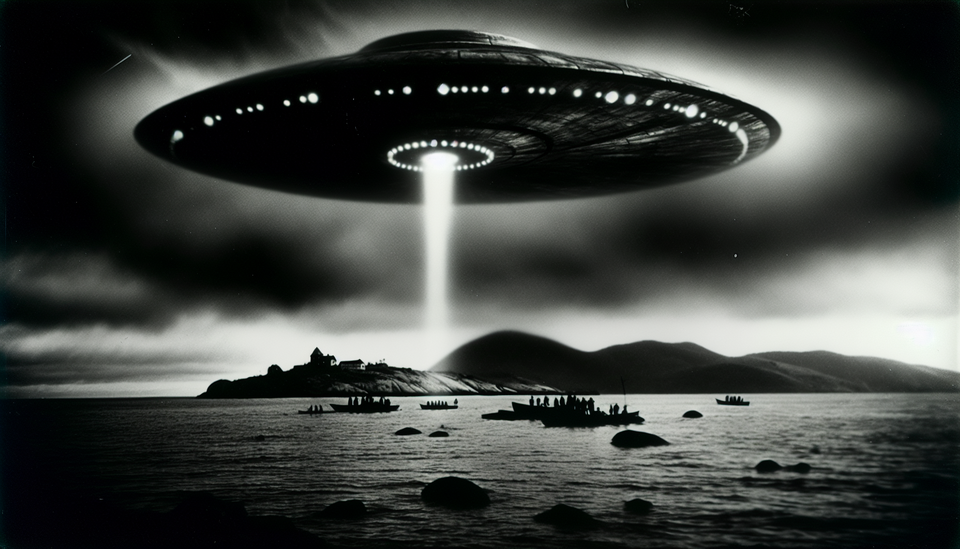
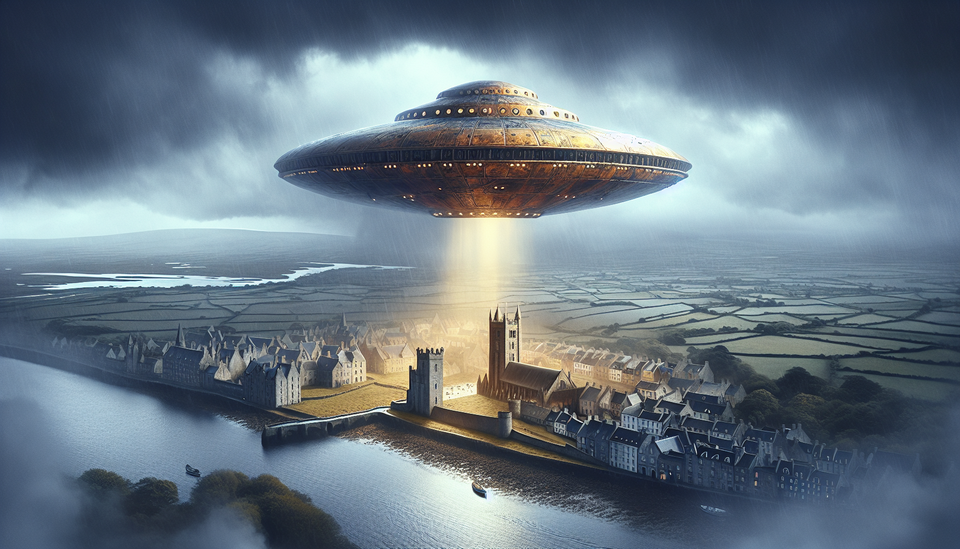
As evening approached, a disc-shaped object appeared over the city's prominent St. Nicholas Church. The witnesses fled in fear. The following day, they reported "trembling all over" and experiencing pain [2].
The Staatliche Museen zu Berlin hosted a major exhibition on this event in 2023, curated by Moritz Wullen. The exhibition concluded: "The general public could not have known that what had actually been witnessed was an atmospheric reflection of a sea battle that was raging just beyond the horizon" [3].
Stralsund 1665 Aerial Battle - Historical Context
Swedish Pomerania and Baltic Conflicts
In 1665, Stralsund was part of Swedish Pomerania, a territory Sweden had acquired after the Thirty Years' War (1618-1648). The Baltic Sea was contested by multiple naval powers including Sweden, Denmark, and the Dutch Republic. Naval engagements were common in these waters during this period [1].
17th Century Interpretation
The phenomenon was interpreted as a "prodigium" (Latin for omen or portent) from God. In the religious worldview of 17th-century Europe, unusual celestial phenomena were commonly viewed as divine messages warning of impending disasters. When lightning struck St. Nicholas Church on June 19, 1670, the 1665 sighting was retroactively connected to divine wrath [2].
Media Sensation
The event became a media sensation. As the Staatliche Museen zu Berlin exhibition documented: "The media spread the news like wildfire, with the publishers of various leaflets and newspapers locked in fierce competition with each other to concoct the most colorful versions and interpretations of events." This early example of media sensationalism shaped how the event was reported and remembered [3].
Futuristic Imagination
The 17th century also saw growing interest in flight. Francesco Lana Terzi published designs for flying boats in this era. The exhibition noted that depictions of the Stralsund event were likely influenced by contemporary futuristic visions of airships, even though actual manned balloon flight would not occur for over 100 years [4].
Stralsund 1665 Aerial Battle - Competing Explanations
Hypothesis 1: Fata Morgana (Scholarly Consensus)
Proponent: Staatliche Museen zu Berlin; Moritz Wullen (curator); modern atmospheric scientists
Description: A Fata Morgana is a complex mirage caused by temperature inversions in the atmosphere that bend light rays, projecting images of distant objects (including ships) into the sky or distorting their appearance.
Supporting evidence:
- The Baltic Sea was an active naval conflict zone in 1665
- Fata Morgana effects are well-documented over cold seas like the Baltic
- The "morphing" effect (birds into ships) is consistent with mirage distortion
- Real naval battles occurring beyond the horizon would be invisible directly but could be reflected by atmospheric conditions
- Museum research states: "What had actually been witnessed was an atmospheric reflection of a sea battle that was raging just beyond the horizon"
Assessment: This is the scholarly consensus explanation, supported by the museum's extensive research [1].
Hypothesis 2: Mass Psychological Experience
Description: The phenomenon may have been a combination of unusual atmospheric conditions and collective interpretation shaped by religious expectations and cultural conditioning.
Supporting evidence: The witnesses' physical symptoms ("trembling," "pain") could indicate psychological trauma or mass suggestion. The religious interpretation framework was powerful in this era.
Assessment: This hypothesis complements rather than contradicts the Fata Morgana explanation [2].
Hypothesis 3: Unidentified Aerial Phenomenon
Proponents: Some UAP researchers cite the "plate-shaped" object
Description: The "flat, round shape like a plate" described at dusk resembles modern UAP reports.
Conflicting evidence:
- The primary phenomenon (battling ships) has a strong conventional explanation
- The "plate" shape may be a mirage distortion of the sun at dusk
- Museum research does not support an anomalous interpretation
Assessment: The scholarly consensus favors atmospheric phenomena over anomalous explanations [3].
- Wullen, Moritz. UFO 1665: Die Luftschlacht von Stralsund / The Air Battle of Stralsund. Wienand Verlag, 2023. ISBN 978-3-86832-750-2. (Exhibition catalog)
- Staatliche Museen zu Berlin. "A UFO in 1665: The Air Battle of Stralsund" (Exhibition, May 5 - August 27, 2023). Kunstbibliothek. Museum website
- Francisci, Erasmus. Der wunder-reiche Uberzug einer andern Welt. 1680. (Contemporary documentation with engraving)
- Vallee, Jacques; Aubeck, Chris. Wonders in the Sky: Unexplained Aerial Objects from Antiquity to Modern Times. Penguin Publishing Group, 2010.
- Colavito, Jason. "Did UFOs Buzz Stralsund on April 8, 1665?" jasoncolavito.com, June 29, 2015. (Skeptical analysis)
Status: EXPLAINED
This case has been thoroughly researched by the Staatliche Museen zu Berlin and is featured in Moritz Wullen's scholarly publication. The scholarly consensus identifies the phenomenon as a Fata Morgana, an atmospheric mirage of a real naval battle occurring beyond the horizon.
Why this case matters:
- Demonstrates how atmospheric phenomena can create dramatic visual effects
- Shows how 17th-century religious frameworks shaped interpretation of natural events
- Illustrates early media sensationalism in reporting unusual phenomena
- Provides context for similar historical "aerial battle" accounts
We include this case because it is well-documented and frequently cited in UAP literature. The strong conventional explanation makes it a valuable example of how historical anomalies can be resolved through modern scientific understanding.