Nuremberg 1561 Celestial Phenomenon
A contemporary illustrated broadsheet depicts and describes a mass sighting over Nuremberg at dawn, featuring spheres, cylinders, crosses, and a large black triangular object, witnessed by the city's population.
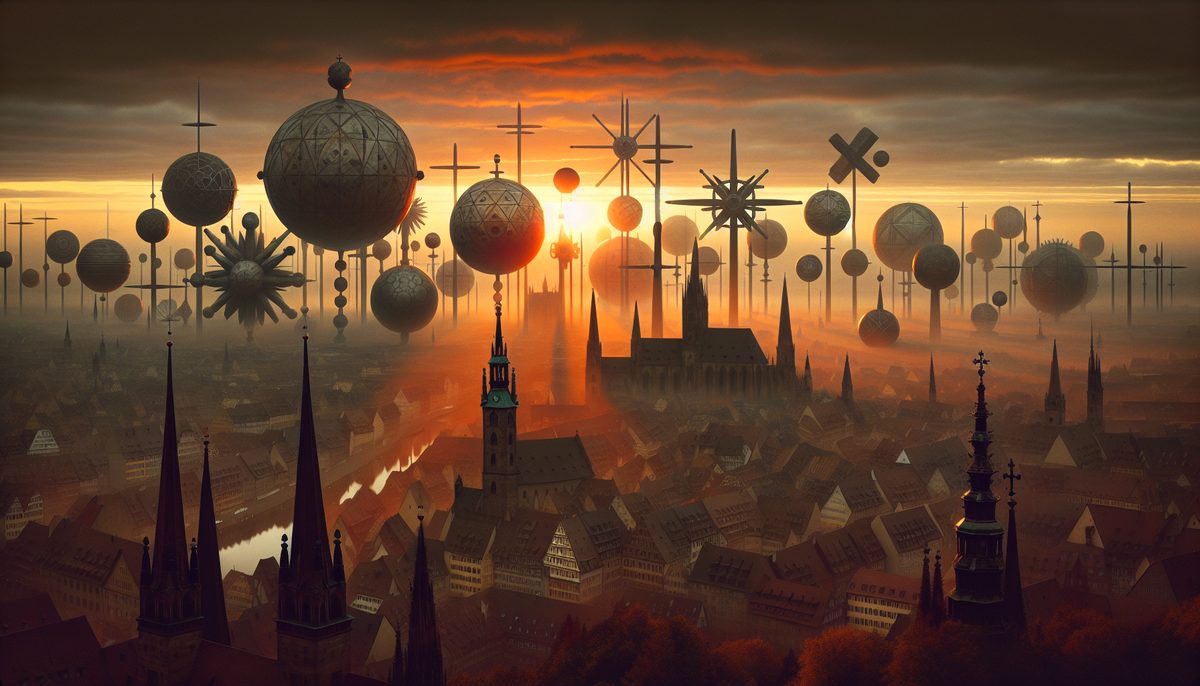
On the morning of April 14, 1561, residents of Nuremberg reported observing a dramatic aerial display that was subsequently immortalized in a woodcut broadsheet by Hans Glaser. The illustration, now held in the Wickiana Collection at the Zentralbibliothek Zürich, depicts numerous objects in the sky including spheres of various colors (blood-red, blue-black, "blood-colored"), cylinders described as tubes from which spheres emerged, cross-shaped objects, and a large black triangular form.
The accompanying text, written in Early New High German, describes the event occurring "at dawn" (am Morgen) when citizens witnessed these objects appearing to engage in a kind of aerial conflict. The account states that some objects fell to earth and were consumed in a "great smoke." The text concludes with religious interpretation, suggesting the display was a divine warning requiring repentance.
The Nuremberg broadsheet represents one of the most detailed contemporary records of a mass anomalous aerial sighting from the medieval period. The primary document survives intact, allowing direct examination. Modern interpretations range from complex atmospheric phenomena (sundogs/parhelia combined with other optical effects) to claims of unexplained aerial objects. The case is notable for its specific visual depiction and the involvement of the entire city population as witnesses.
Historical Context
Nuremberg in 1561 was one of the most important cities in the Holy Roman Empire, a major center of commerce, printing, and culture. The city had a sophisticated population including numerous skilled craftsmen, merchants, and intellectuals. The printing industry was highly developed, enabling rapid production of illustrated broadsheets (Flugblätter) that served as popular news media.
Broadsheet publisher Hans Glaser was a known producer of such illustrated news sheets, which covered events from battles to unusual phenomena. The religious interpretation in the text reflects the standard framework of the period: unusual celestial events were commonly interpreted as divine messages. However, the document separates observational description from religious interpretation, providing both the reported phenomena and the cultural response.
Event Timeline
Witness Accounts
"The globes... appeared in large numbers and fell to the ground...and then rose again up high where they flew together and began to fight one another."
Physical Evidence
Competing Explanations
Complex atmospheric optical phenomena (parhelia/sundogs, light pillars, halos) [3][4]
The timing at dawn is consistent with conditions producing parhelia. Solar halos can create cross shapes. Multiple simultaneous optical phenomena could create complex display. The period had no vocabulary for such meteorological optics.
The described variety of distinct object types (spheres, cylinders, triangles) exceeds typical parhelion complexity. Objects reportedly emerged from tubes and moved independently. Some described falling to earth with smoke.
Unexplained aerial objects of unknown origin [4]
The detailed visual record shows diverse structured objects. The mass sighting involved the entire city population. Behaviors described (emerging, moving, falling) suggest distinct objects rather than optical effects.
No physical evidence recovered. Contemporary understanding would filter observation through available concepts. Similar broadsheets sometimes embellished or combined reports.
Religious/prophetic vision or collective psychological phenomenon [3]
The religious interpretation was primary for contemporary witnesses. Mass psychological phenomena can produce shared unusual perceptions. The period expected and actively sought divine signs.
The detailed visual depiction suggests observational basis. Glaser separated description from interpretation. The specificity exceeds typical visionary accounts.
Astronomical event combined with atmospheric conditions [4]
Meteor storms can produce multiple bright objects. Combined with morning atmospheric effects, could create unusual display. April conditions can produce notable atmospheric optics in the region.
No known major meteor event recorded for that date. The described behaviors (emerging from tubes, falling with smoke in specific locations) do not match meteor phenomena.