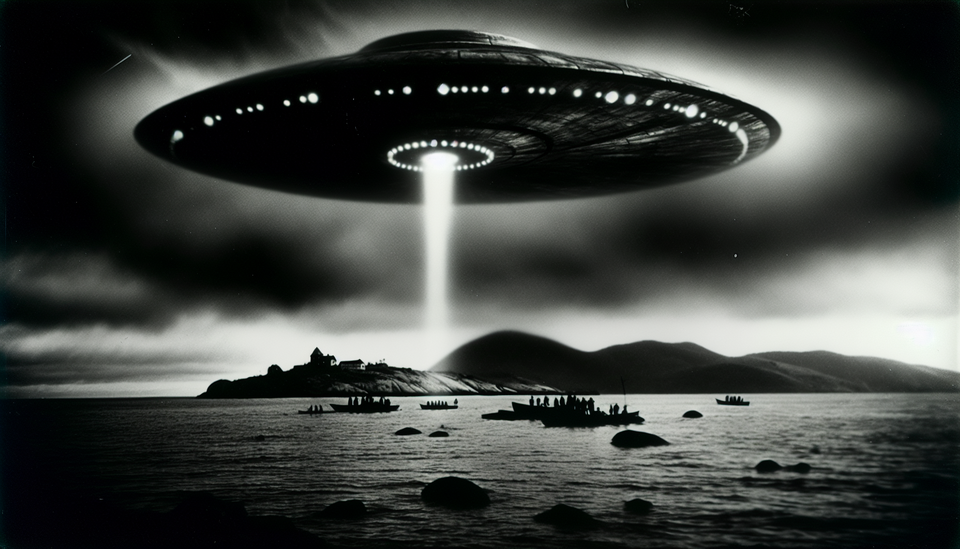
Nash-Fortenberry 1952: Red Discs Over Chesapeake Bay
Two Pan American pilots observed eight glowing red discs flying in echelon formation over Chesapeake Bay, making instant direction changes. Project Blue Book classified the case as "UNKNOWN" and seven independent ground witnesses corroborated the sighting.

On the night of July 14, 1952, Pan American World Airways pilots William B. Nash and William H. Fortenberry were flying a DC-4 at 8,000 feet over Chesapeake Bay when they observed six bright red, disc-shaped objects approaching at tremendous speed. The objects were flying in a tight stepped-down echelon formation, glowing like "hot coals."
As the formation approached Newport News, the six discs abruptly flipped on edge in unison, reversed direction, and were joined by two additional objects from below. All eight then climbed away at an estimated speed exceeding 12,000 mph. The entire observation lasted approximately 12 seconds, during which the pilots noted the objects were clearly defined, approximately 100 feet in diameter, and about 15 feet thick.
The case was investigated by Air Force personnel who interviewed the pilots extensively. Project Blue Book classified the sighting as "Unknown" — one of only 701 cases (out of 12,618) to receive this designation. Independent ground witnesses in the Norfolk area also reported seeing red lights that night, providing potential corroboration.
Nash-Fortenberry 1952 Red Discs - Context
The Nash-Fortenberry sighting occurred during the historic 1952 UFO wave, one of the most intense periods of UFO activity in American history. Just days later, on July 19-20 and July 26-27, UFOs would be tracked on radar over Washington, D.C., prompting nationwide media coverage and the largest Pentagon press conference since World War II.
The case is considered significant because it involved trained commercial pilots with clear visibility, allowed for precise geometric calculations based on known landmarks, and was corroborated by independent ground witnesses. The objects' coordinated maneuvering—flipping on edge simultaneously and reversing direction without any turning radius—defied the aerodynamic capabilities of any known 1952 aircraft.
Nash and Fortenberry later wrote about their experience for True magazine in 1967, maintaining the accuracy of their original account despite years of scrutiny and alternative explanations proposed by skeptics.
Nash-Fortenberry 1952 Red Discs - Incident Timeline
Nash-Fortenberry 1952 Red Discs - Competing Explanations
Mirage of Venus [3]
Skeptic Steuart Campbell proposed atmospheric conditions could create multiple images of celestial objects.
Venus was not in the reported direction; pilots observed structured, disc-shaped objects with defined edges, not point-source lights.
Ground lights distorted by haze [4]
Donald Menzel suggested haze over Chesapeake Bay could distort ground illumination.
Objects moved at extreme speed across the sky, changed altitude, and exhibited coordinated maneuvers inconsistent with stationary lights.
Fireflies trapped in cockpit glass [4]
Menzel later proposed fireflies between window panes could create moving light effects.
Both pilots observed objects outside the aircraft through clear visibility; independent ground witnesses reported similar lights.
Unknown aerial phenomenon [1][2]
Trained pilot observers, precise observations against known landmarks, corroborating ground witnesses, Project Blue Book "Unknown" classification.
No physical evidence recovered; single brief observation.
Nash-Fortenberry 1952 Red Discs - Eyewitness Testimony
"Their edges were well-defined, not phosphorescent or fuzzy. The red-orange color was uniform over the entire surface of each disc."
"They flipped on edge, all in unison, and darted off in the direction from which they had come."
Nash-Fortenberry 1952 Red Discs - Physical Evidence
[NO PHYSICAL EVIDENCE RECOVERED]