Mystery Airships 1896-1897: America's First UFO Wave
Thousands of Americans reported seeing mysterious airships in the sky before practical aviation existed. The wave began in Sacramento on November 17, 1896, and spread eastward, generating over 100,000 witness accounts documented in contemporary newspapers.
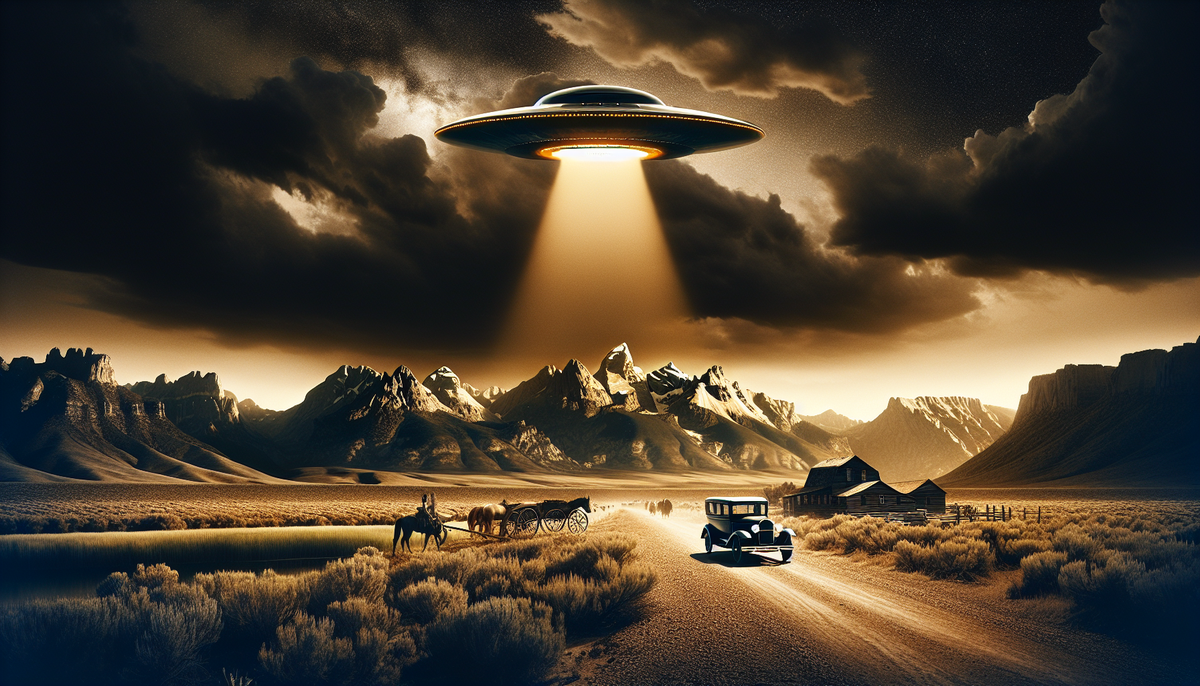
AI visualization based on witness descriptions. This is a dramatization, not a photograph.
Thousands of Americans reported seeing mysterious airships in the sky before practical aviation existed. The wave began in Sacramento on November 17, 1896, and spread eastward, generating over 100,000 witness accounts documented in contemporary newspapers.
100,000+ESTIMATED WITNESSES
Between November 1896 and May 1897, thousands of Americans across the country reported seeing mysterious aerial craft in the night sky. The phenomenon began in Sacramento, California, on November 17, 1896, when multiple witnesses observed a bright light moving slowly at an estimated 1,000 feet elevation. Over the following months, similar sightings spread eastward across the United States.
Witnesses typically described seeing bright lights, but some reported detailed observations of cigar-shaped or dirigible-like craft, sometimes with visible occupants. In certain accounts, witnesses claimed to have encountered the craft's crew, who were usually described as human but sometimes claimed to be from Mars.
The mystery airship wave occurred during the "yellow journalism" era, and many accounts were likely hoaxes or misidentifications. However, historian Mike Dash noted that while most sightings could be explained as planets, stars, hoaxes, or practical jokes, "a small residuum remains perplexing." The wave is considered a cultural predecessor to the modern UFO phenomenon that began in 1947.
Historical Context
The 1890s were a period of intense technological innovation and widespread belief that practical airship flight was imminent. Science fiction featuring airships was extremely popular, including the Frank Reade Library stories and Jules Verne's "Robur the Conqueror" (1887). This cultural context likely influenced both witness perception and press coverage.
Although experimental airships existed (Solomon Andrews' Aereon flew in 1863; Frederick Marriott demonstrated a small airship in 1869), the technology of the era could not have produced craft matching the reported capabilities. No documented test flights of long-range powered airships occurred during this period.
The "yellow journalism" era of the 1890s was characterized by sensationalized reporting and newspapers sometimes publishing stories editors and readers understood to be fictional entertainment rather than factual news. This complicates assessment of contemporary accounts. After the wave ended in 1897, the phenomenon was largely forgotten until UFO researchers rediscovered the newspaper archives in the 1960s.
Timeline
November 17, 1896 - Evening
Sacramento, California
First widely reported sighting: multiple citizens observe bright light moving at ~1,000 ft. Witness R.L. Lowery claims to hear voices from craft. [1]
November 18, 1896
California
Sacramento Bee and San Francisco Call publish accounts with headlines including "A Wandering Apparition" and "Claim They Saw a Flying Airship" [1]
November 19, 1896
Lodi, California
Colonel H.G. Shaw claims encounter with landed craft and 7-foot-tall beings who attempted to force him aboard [2]
November 21, 1896
Sacramento and SF Bay Area
Light seen by thousands including deputy sheriff, district attorney, and Mayor Sutro's staff. Reportedly frightened seals at Seal Rocks. [1]
November 22, 1896
Knights Ferry, California
Two Methodist ministers observe "fiery object" on ground that takes off as they approach [1]
November 29, 1896
Tulare, California
Over 100 residents witness airship with red, white, and blue lights heading toward Hanford [1]
January-May 1897
Midwest United States
Wave spreads eastward with sightings reported across Texas, Kansas, Nebraska, Iowa, Illinois, and other states [3]
April 17, 1897
Aurora, Texas
Alleged airship crash reported (separate case file) [4]
Witness Accounts
R.L. LowerySacramento resident, initial witness[Quoted in Sacramento Bee, November 18, 1896]
"[Heard] a voice from the craft issuing commands to increase elevation in order to avoid hitting a church steeple... powered by two men exerting themselves on bicycle pedals."
First detailed account, November 17, 1896. Lowery added wry humor suggesting awareness of potential skepticism. [1]
Colonel H.G. ShawReported as Colonel; account published in Stockton Daily Mail[Account published November 19, 1896]
"[Encountered] three slender, 7-foot-tall beings emitting a strange warbling noise... they tried to physically force him to accompany them back to the airship."
One of the earliest "close encounter" accounts. Shaw believed the beings were Martians. [2]
"[Observed] light twice as bright as a typical arc light or locomotive headlamp"
Credentialed witnesses whose observations added legitimacy to reports [1]
Mayor Adolph Sutro's domestic staffHousehold employees of San Francisco Mayor[Reported in San Francisco Call, November 1896]
"[Observed craft over] Cliff House and Seal Rocks [which] reportedly frightened the sleeping seals, causing them to frantically dive into the ocean."
Indirect witness via mayoral household, San Francisco [1]
Documentary Evidence
Documentary
Extensive contemporary newspaper coverage in Sacramento Bee, San Francisco Call, Stockton Daily Mail, and hundreds of other publications across the United States. Thousands of individual accounts documented. [1][3]
Status: Preserved in newspaper archives. Accessible through historical newspaper databases and library collections.
Illustrations
Contemporary newspaper illustrations depicting witness descriptions of the airships. Notable examples in San Francisco Call (November 22, 1896; November 29, 1896). [1]
Status: Images preserved and reproduced in UFO literature and historical studies.
Competing Explanations
Misidentification of astronomical objects [3]
Supporting Evidence
Many sightings occurred at night and involved only lights. Planets (especially Venus), bright stars, and meteors were frequently misidentified in the era before widespread astronomical literacy. Historian Mike Dash concluded "a considerable number of the simpler sightings were misidentification of planets and stars."
Conflicting Evidence
Does not account for detailed craft descriptions, multiple witnesses tracking objects moving across the sky, or close encounter reports.
Hoaxes and yellow journalism fabrications [1][3]
Supporting Evidence
The 1890s "yellow journalism" era was known for sensationalized and fabricated stories. Dash noted "a large number of the more complex [sightings were] the result of hoaxes and practical jokes." Some editors expected readers to recognize fictional accounts. Known hoaxers confessed after the fact.
Conflicting Evidence
The sheer volume and geographic spread of reports makes coordinated hoaxing difficult. Many witnesses were prominent citizens (lawyers, ministers, government officials) with reputations at stake.
Secret inventor testing advanced craft [1][2]
Supporting Evidence
Contemporaries widely believed a genius inventor was secretly testing an airship. Several individuals claimed to be the inventor or to know him. This matched popular cultural narratives (Frank Reade stories, Jules Verne).
Conflicting Evidence
No evidence of any such inventor or craft has ever emerged. Technology of the era could not produce airships with reported capabilities. "It would have been impossible, not to mention irrational, to keep such a thing secret."
Unexplained aerial phenomena [3][5]
Supporting Evidence
Historian Dash acknowledged "a small residuum remains perplexing." Some sightings involved multiple credible witnesses, detailed descriptions, and apparent structured craft. The wave pattern and witness profiles resemble later UFO waves.
Conflicting Evidence
The cultural context (airship mania, yellow journalism) makes objective assessment difficult. No physical evidence survived. Most individual cases have prosaic explanations.
Methods: Contemporary journalists interviewed witnesses and published accounts. Modern researchers conducted archival research, analyzed patterns, and evaluated individual cases against known phenomena and hoax characteristics.
Finding: Most sightings attributable to misidentification or hoaxes; "a small residuum remains perplexing" (Dash). No physical evidence recovered. Wave pattern and witness profiles established template for later UFO waves.
Conclusion: The mystery airship wave represents a genuine social phenomenon with multiple causal factors. While most individual cases have prosaic explanations, the wave's scale, pattern, and some specific accounts resist simple explanation. [3][5]
Scholarly Debate: Skeptics emphasize yellow journalism context and lack of physical evidence; UFO researchers see the wave as evidence of ongoing aerial phenomena; historians focus on cultural and psychological factors
SOURCE LOG
[1]Reece, Gregory L. "UFO Religion: Inside Flying Saucer Cults and Culture." I.B. Tauris, 2007. Comprehensive analysis of the 1896-97 wave.[secondary]
[2]Stockton Daily Mail, November 19, 1896. Colonel Shaw encounter account.[primary]
[3]Dash, Mike. "A Note on the Mystery Airships of 1896-1897." In: Fortean Studies, Volume 1. John Brown Publishing, 1994.[secondary]
[4]Cohen, Daniel. "The Great Airship Mystery." Dodd, Mead, 1981.[secondary]
[5]Clark, Jerome. "The UFO Encyclopedia." Omnigraphics, 2018. Entry on mystery airships with extensive bibliography.[secondary]
[6]Bartholomew, Robert E. "The Airship Hysteria of 1896-97." Skeptical Inquirer, Vol. 14, 1990.[secondary]
Editorial Note: The 1896-97 mystery airship wave is one of the most complex cases in pre-modern UFO history. While most individual sightings can be attributed to misidentification or the hoax-prone journalism of the era, the wave's scale and persistence warrant serious historical study. UAPI presents this case with appropriate acknowledgment of both the cultural context and the genuinely puzzling aspects that historian Mike Dash identified.