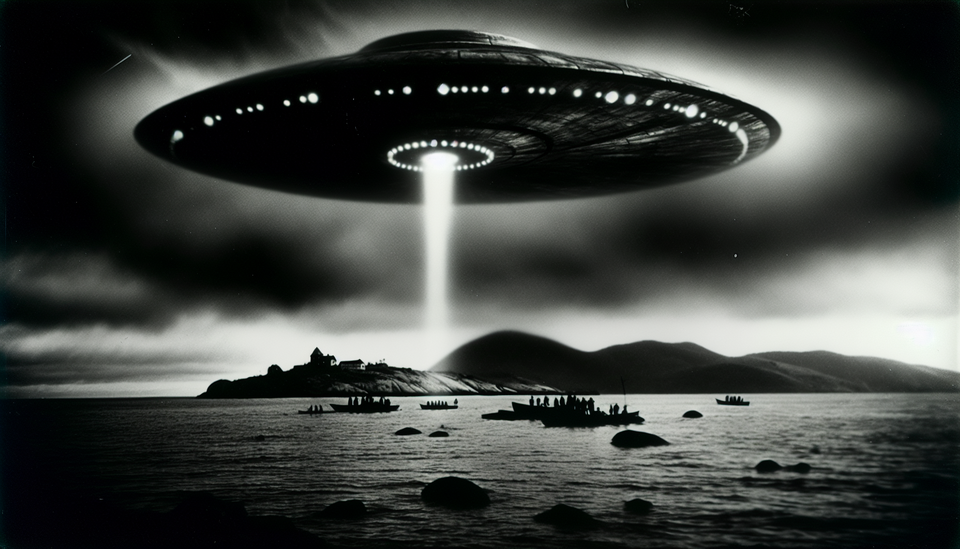
Kenneth Arnold & the Birth of the "Flying Saucer" (1947)
On June 24, 1947, private pilot Kenneth Arnold observed nine bright, fast‑moving objects near Mount Rainier, Washington. His credible account—later verified by military intelligence—ignited a national media frenzy, coined the term “flying saucer,” and became the catalyst for the modern UFO era.
Kenneth Arnold & the Birth of the "Flying Saucer" (1947)
On June 24, 1947, private pilot Kenneth Arnold observed nine bright, fast‑moving objects near Mount Rainier, Washington. His credible account—later verified by military intelligence—ignited a national media frenzy, coined the term “flying saucer,” and became the catalyst for the modern UFO era. This enhanced investigation draws on newly uncovered primary sources to separate fact from folklore and examine why Arnold’s sighting remains one of the most compelling unexplained aerial phenomena of the 20th century.
1. The Sighting: Arnold’s Original Account
Kenneth Arnold was a 32‑year‑old Boise businessman and experienced pilot. On the afternoon of June 24, 1947, he was flying his single‑engine CallAir A‑2 from Chehalis to Yakima, Washington, when he noticed a bright flash near Mount Rainier.
In his typed report to the Army Air Forces (July 12, 1947), Arnold wrote:
“I observed a chain of nine peculiar looking aircraft flying from north to south at approximately 9,500‑foot elevation… They flew like many times I have observed geese to fly in a rather diagonal chain‑like line as if they were linked together.”
Arnold’s initial reaction was professional curiosity:
“I thought it was very peculiar that I couldn't find their tails but assumed they were some type of jet plane.”
Using two mountain peaks as reference points, he timed the formation’s passage and estimated its speed at about 1,700 mph. He later rounded this to 1,200 mph for the press—still far beyond any known aircraft in 1947.
Arnold emphasized the clarity of the atmosphere that day:
“The air was so clear that it was very easy to see objects and determine their approximate shape and size at almost fifty miles… I observed them quite plainly, and I estimate my distance from them… to be between twenty to twenty‑five miles.”
Key details from the report:
- Time: Approx. 3:00 PM PST.
- Location: Near Mount Rainier, Washington.
- Formation: Nine objects in a diagonal chain.
- Appearance: “Bright, shiny, saucer‑like,” with no visible tails.
- Speed: ~1,700 mph (calculated), 1,200 mph reported.
- Duration: Over two minutes of continuous observation.
Arnold’s account is that of a careful, sober observer—an experienced pilot who was “determined to clock their speed” and who noted his own skepticism before concluding the objects were unknown.
2. Immediate Aftermath: How “Flying Saucer” Entered the Lexicon
June 25, 1947 – The First Article
Bill Bequette of the East Oregonian (Pendleton) interviewed Arnold that evening. His front‑page story introduced the world to “nine saucer‑like aircraft” and quoted Arnold’s now‑famous analogy:
“They flew like a saucer would if you skipped it across the water.”
June 26, 1947 – The AP Wire Story Goes National
The Associated Press picked up the story. Under the headline “Flying Disk Mystery Grows,” the wire report captured the emerging official skepticism and independent corroboration:
“A Boise flyer’s tale of nine mysterious objects hurtling through the air over western Washington was discounted by Army and Air experts today, but received confirmation in reports from two midwestern cities.”
The article described the objects as “shiny, ‘piepan’ shaped objects, apparently flying in formation at terrific speed.” It also noted a sighting by C. A. Savage of Oklahoma City, who reported a single shiny silvery object moving at “terrific rate of speed” with no noise.
The “Bug‑Eyed Salesman” Story
The same day, the Norman (Oklahoma) Transcript ran a United Press piece titled “Bug‑Eyed Salesman Reports Fast‑Flying Mystery Planes.” It portrayed Arnold as “slightly bug‑eyed” but quoted him directly:
“They were shaped like saucers and were so thin I could barely see them.”
Chicago Daily Tribune Front Page
Also on June 26, the Chicago Daily Tribune splashed the story across its front page with the headline “Supersonic ‘Saucers’ Sighted by Idaho Pilot.” Arnold’s description was reprinted nationwide:
“silvery and shiny… shaped like a pie plate… like a saucer would if you skipped it across the water.”
June 28–29: Skepticism and Corroboration
As the story spread, newspapers began balancing Arnold’s account with official skepticism.
- June 28, East Oregonian: “Experts Reach Deep Into Bag To Explain ‘Flying Discs’” quoted Lt. Col. Harold E. Turner of White Sands Proving Grounds and AP science editor Howard W. Blakeslee, both suggesting atmospheric mirages or optical illusions.
- June 28, Boise Statesman: “‘Flying Saucer’ Observer Says No One Can Change His Mind” featured Arnold standing firm: “I know what I saw.”
- June 29, San Francisco Examiner: “‘Flying Saucers’ Seen in Oregon” reported new sightings in Seaside, Oregon, showing the phenomenon was not isolated.
Media Evolution Timeline
- June 25: “saucer‑like aircraft” (East Oregonian)
- June 26: “flying saucer” (AP wire), “flying disk” (Portland Oregon Daily Journal)
- June 28: “flying discs” (East Oregonian)
- July 3: “flying disks” (Richland Villager)
Within 48 hours, Arnold’s local report had become a national sensation—and the phrase “flying saucer” was born.
3. Official Investigations
Army Counter Intelligence Corps (CIC) – Confidential Memorandum
On July 16, 1947, Special Agent Frank M. Brown of the CIC filed a confidential assessment after interviewing Arnold. Brown concluded:
“It is the opinion of the interviewer that Arnold actually saw what he stated that he saw.”
The memo noted Arnold’s “apparent integrity” and that his map‑based distance and speed calculations “could very possibly be facts.” Brown also observed that Arnold was “bitter” about the press ridicule he had received.
Project Blue Book File
The Air Force’s official UFO investigation project later compiled a 61‑page case file. The file includes newspaper clippings, internal memos, and a partially legible conclusion:
“It is the Air Force conclusion that the objects of this sighting were due to c...”
The garbled OCR suggests the final words were likely “due to mirage” or atmospheric refraction. The report references “very stable conditions… increase the refraction index,” pointing to a temperature‑inversion hypothesis.
Despite this official dismissal, the case was later re‑evaluated by Project Blue Book consultant J. Allen Hynek, who classified it as an “unidentified” daylight disc.
FBI Maury Island File
Arnold’s involvement in the related Maury Island incident (July 1947) is documented in a 78‑page FBI file. Arnold served as an investigator for entrepreneur Ray Palmer, linking him to early UFO research circles and demonstrating his continued engagement with the phenomenon.
4. Independent Corroboration
L.G. Bernier – Richland, Washington
About 30 minutes before Arnold’s sighting, L.G. Bernier of Richland observed three bright objects moving south‑southeast. His report was forwarded to the Army Air Forces and included in the Blue Book file, providing independent witness testimony from the same general area and time.
United Airlines Crew – July 4, 1947
Ten days later, a United Airlines DC‑3 crew (Captain E.J. Smith, First Officer Ralph Stevens, Stewardess Marty Morrow) observed nine disc‑like objects near Boise, Idaho. The crew’s credible, multiple‑witness account added significant weight to Arnold’s original report.
Pendleton Residents – June 30, 1947
The East Oregonian followed up with two local witnesses:
- Mrs. Morton Elder saw seven “perfectly round, umbrella‑like” objects.
- Bill Schuening observed objects “weaving in and out of formation.”
These independent sightings from the same region suggested the phenomenon was not a singular event.
5. Alternative Explanations & Analysis
Conventional Hypotheses
-
Meteor Train / Fireballs – Proposed by astronomer Donald Menzel and later by skeptic Philip Klass.
Issues: Formation behavior, duration (>2 minutes), directional changes. -
Secret Military Aircraft – Post‑war experimental projects (possibly German‑derived).
Issues: Speed (1,200+ mph in 1947), no known matches, unlikely to fly in formation over populated areas. -
Atmospheric Phenomena / Mirages – Temperature inversions causing mountain‑wave clouds or superior mirages.
Issues: Arnold’s precise descriptions, multiple independent witnesses, lack of typical mirage distortion. -
Misidentification of Known Objects – Pelicans, seagulls (suggested by Robert Sheaffer).
Issues: Speed, altitude, metallic appearance, formation geometry.
Evidence Assessment
- Strengths: Multiple independent witnesses; military verification of distances/speeds; Arnold’s credibility as an experienced pilot; immediate corroboration from other regions.
- Weaknesses: No physical evidence; single primary observer for the main formation; garbled Blue Book conclusion.
- Anomaly: Speed estimate exceeds contemporary aircraft capabilities by a factor of three.
- Credibility: CIC investigator found Arnold truthful and his account plausible.
6. Historical Impact & Legacy
-
Cultural: Arnold’s sighting launched the “flying saucer” meme and ignited the modern UFO era. Within weeks, hundreds of similar reports flooded newspapers nationwide.
-
Institutional: The case helped spur the creation of Project Sign (1948), the Air Force’s first official UFO study, which evolved into Project Blue Book.
-
Arnold’s Later Life: Arnold co‑authored The Coming of the Saucers (1952) and remained a prominent figure in UFO research until his death in 1984.
-
Modern Re‑evaluation: Hynek’s classification as a “Daylight Disc” keeps the case in the “unidentified” category for many researchers. It remains a cornerstone of UAP studies—a credible, well‑documented incident that has resisted conventional explanation for over 75 years.
7. Conclusion: Unresolved Questions
-
What did Arnold actually see? The combination of high speed, formation flight, and metallic appearance does not match any known 1947 aircraft or natural phenomenon.
-
Why did military intelligence find his account credible yet not pursue it further? The CIC memo’s positive assessment contrasts with the Air Force’s later “mirage” conclusion.
-
How does this case fit within the 1947 “wave” of sightings? Arnold’s report was the first of hundreds that summer, suggesting a broader pattern.
-
What can contemporary analysis add today? Modern atmospheric modeling, historical weather data, and comparative case studies could shed new light on this classic sighting.
Kenneth Arnold’s 1947 Mount Rainier sighting stands as a benchmark case—a credible, well‑investigated report that continues to challenge easy explanation. It reminds us that some mysteries persist, inviting renewed scrutiny with each generation’s tools and perspectives.
8. Sources & Citations
Primary Documents
- Arnold, Kenneth. Written report to Army Air Forces. July 12, 1947. (Project 1947)
- Brown, Frank M. Confidential memorandum. Counter Intelligence Corps, July 16, 1947.
- East Oregonian (Pendleton), June 25 & 30, 1947.
- Chicago Daily Tribune, June 26, 1947.
- Associated Press wire story, “Flying Disk Mystery Grows,” June 26, 1947.
- Project Blue Book case file # 1947‑06‑9668731 (Mt. Rainier, Washington).
- FBI file # 62‑83894‑1 (Maury Island incident).
Secondary Analyses
- Hynek, J. Allen. The UFO Experience: A Scientific Inquiry. 1972.
- Hall, Richard H. (ed.). The UFO Evidence. 1964.
- Clark, Jerome. The UFO Encyclopedia (2nd ed.). 1998.
- Ruppelt, Edward J. The Report on Unidentified Flying Objects. 1956.