Kenneth Arnold 1947: The Sighting That Started It All
Private pilot Kenneth Arnold observed nine objects traveling at unprecedented speeds near Mount Rainier, coining the term "flying saucer" and launching the modern UFO era. Multiple independent witnesses corroborated the sighting.
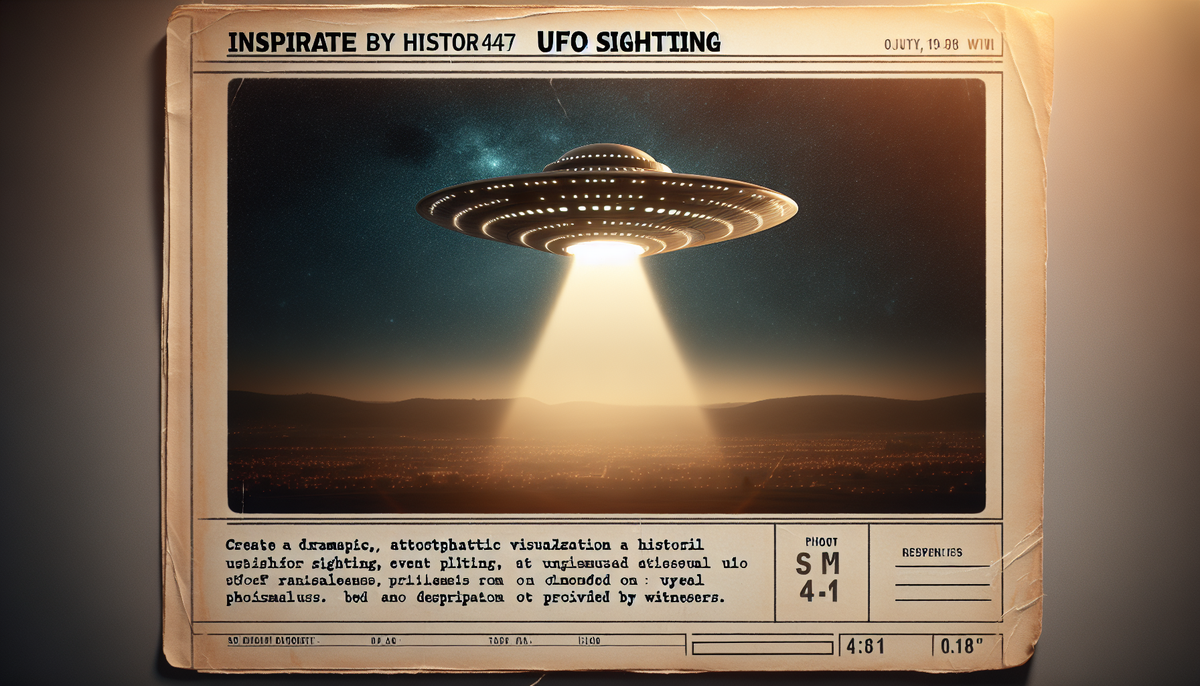
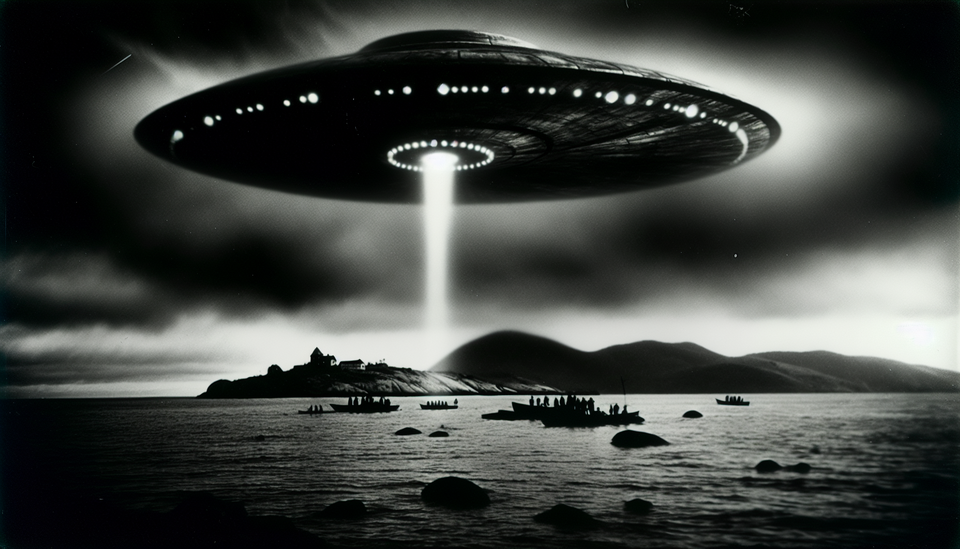
AI visualization based on witness descriptions. This is a dramatization, not a photograph.
CASE IDUAPI-1947-001
DATEJune 24, 1947
LOCATIONNear Mount Rainier, Washington
COORDINATES46.85°N 121.76°W
CLASSIFICATIONVISUAL-MULTIPLE-WITNESS
EVIDENCE QUALITYHIGH
Private pilot Kenneth Arnold observed nine objects traveling at unprecedented speeds near Mount Rainier, coining the term "flying saucer" and launching the modern UFO era. Multiple independent witnesses corroborated the sighting.
1,700 MPHESTIMATED SPEED
On June 24, 1947, at approximately 3:00 PM, private pilot Kenneth Arnold observed nine unidentified objects flying in formation near Mount Rainier, Washington. Arnold, a respected businessman and experienced pilot, was flying a CallAir A-2 at 9,200 feet altitude when he spotted the objects traveling from Mount Rainier toward Mount Adams at speeds he calculated to be between 1,200 and 1,700 mph, far exceeding any known aircraft of the era.
Arnold described the objects as thin, flat, and reflective, with a motion "like saucers skipping across water." His account, first published in the East Oregonian on June 25, sparked nationwide press coverage and is credited with launching the modern era of UFO sightings. The term "flying saucer" entered public vocabulary through press coverage of his report.
Multiple independent witnesses corroborated Arnold's sighting. L.G. Bernier in Richland, Washington reported seeing three similar objects heading toward Mount Rainier approximately thirty minutes before Arnold. A Washington State forest service member at Diamond Gap reported "flashes" over Mount Rainier at exactly 3:00 PM. Ten days later, a United Airlines crew over Idaho reported 5-9 disk-like objects pacing their aircraft. Army Air Forces intelligence investigated and found Arnold credible.
Support Independent UAP Research
Get exclusive case analyses, deep‑dive reports, and behind‑the‑scenes updates.
The Kenneth Arnold sighting occurred less than two years after the end of World War II, during a period of rapid technological advancement and Cold War tensions. The sound barrier had not yet been officially broken (Chuck Yeager would accomplish this in October 1947). No publicly known aircraft could achieve the speeds Arnold reported.
Arnold was searching for a downed Marine Corps C-46 transport, for which a $5,000 reward had been offered. Weather conditions were ideal: clear skies with mild wind. Arnold was an experienced pilot familiar with aircraft identification and capable of making careful observations.
The post-war period saw increased interest in rocket technology and speculation about advanced aircraft. However, the specific characteristics Arnold described, including the objects' erratic weaving motion and extreme speed, did not match any known experimental aircraft. The sighting would trigger thousands of additional reports over the following weeks, establishing a pattern of UFO waves that continues to the present.
Timeline
June 24, 1947 - 14:15
Chehalis, Washington
Kenneth Arnold departs in CallAir A-2, heading to Yakima via Mount Rainier area [1]
June 24, 1947 - c. 14:30
Richland, Washington
L.G. Bernier observes three objects flying toward Mount Rainier (approximately 30 minutes before Arnold) [2]
June 24, 1947 - 14:59
Near Mineral, Washington
Arnold at 9,200 ft notices bright flash; spots nine objects in echelon formation near Mount Rainier [1]
June 24, 1947 - 15:00:00
Mount Rainier
Objects pass in front of Mount Rainier; Arnold opens side window to observe without glass interference [1]
June 24, 1947 - 15:00:00
Diamond Gap, Washington
Washington State forest service member reports seeing "flashes" over Mount Rainier [3]
June 24, 1947 - 15:01:42
Mount Adams
Objects fade from view near Mount Adams; Arnold calculates 50-mile transit in 1 min 42 sec (1,700 mph) [1]
June 24, 1947 - c. 16:00
Yakima, Washington
Arnold lands, describes sighting to pilot friends who suggest military test craft [1]
June 25, 1947
Pendleton, Oregon
Arnold interviewed by East Oregonian reporters Nolan Skiff and Bill Bequette; first news story published [4]
June 26, 1947
Nationwide
Story appears in newspapers across US and Canada; terms "flying saucer" and "flying disc" enter vocabulary [4]
July 4, 1947
Over Idaho
United Airlines crew reports 5-9 disk-like objects pacing their aircraft for 10-15 minutes [5]
July 12, 1947
Hamilton Field, California
Lt. Frank Brown and Capt. William Davidson of Army Air Forces intelligence interview Arnold [6]
Witness Accounts
Kenneth ArnoldPrivate pilot, businessman, experienced in aerial observation. 32 years old at time of sighting.[Interviewed by multiple reporters June 25-26; Army Air Forces intelligence July 12; Edward R. Murrow 1950]
"I observed a chain of nine peculiar looking aircraft flying from north to south at approximately 9,500 feet elevation and going, seemingly, in a definite direction of about 170 degrees... They seemed to flip and flash in the sun, just like a mirror."
Official report to Army Air Forces intelligence, July 12, 1947 [6]
L.G. BernierRichland, Washington resident[Letter published in Oregon Journal, July 4, 1947; interviewed by Richland Washington Villager, July 3]
"I saw three of the strange objects over Richland flying almost edgewise toward Mount Rainier about one half-hour before Arnold... these discs certainly were traveling faster than any P-38."
Independent corroborating witness, 110 miles east of Mount Adams [2]
Forest Service Lookout (unnamed)Washington State forest service member, fire watch duty[Interviewed by Army Air Forces intelligence in early July]
"[Observed] flashes at 3:00 p.m. on the 24th over Mount Rainier that appeared to move in a straight line."
Diamond Gap lookout tower, 20 miles south of Yakima, exact same time as Arnold sighting [3]
United Airlines CrewCommercial airline pilots and crew[Reported to authorities; discussed with Arnold]
"[Spotted] five to nine disk-like objects that paced their plane for 10 to 15 minutes before suddenly disappearing."
Over Idaho, July 4, 1947, ten days after Arnold sighting [5]
Documentary Evidence
Documentary
Arnold's written report to Army Air Forces intelligence, July 12, 1947, including annotated sketches of the observed objects. [6]
Status: Preserved in Project Blue Book files. Available through National Archives.
Documentary
Original newspaper coverage: East Oregonian (June 25, 1947), Associated Press wire service stories, Chicago Sun (June 26, 1947). [4]
Status: Preserved in newspaper archives. Extensively reproduced.
Audio
Recorded radio interview by Ted Smith, United Press correspondent, aired June 26, 1947 on KWRC Pendleton. [4]
Status: Recording preserved. Arnold describes objects as "something like a pie plate that was cut in half with a sort of a convex triangle in the rear."
Competing Explanations
Observation of genuine unidentified aerial phenomena [1][4][5]
Supporting Evidence
Multiple independent witnesses at different locations reported similar objects at the same time. Arnold was an experienced pilot with no motive to fabricate. Army Air Forces investigators found him credible. Objects exhibited characteristics (speed, maneuverability) exceeding known technology. United Airlines crew corroboration 10 days later. Historian Mike Dash: Arnold "had the makings of a reliable witness."
Conflicting Evidence
No physical evidence recovered. Speed estimates depend on distance calculations that could contain errors. Single primary witness for main observation.
Misidentification of conventional aircraft or military test [1][6]
Supporting Evidence
Post-war period saw rapid aircraft development. Arnold initially suspected military test aircraft. Formation flying suggests organized vehicles.
Conflicting Evidence
No aircraft in 1947 could achieve 1,200-1,700 mph; sound barrier not yet broken. Army Air Forces had no record of test flights matching description. Objects exhibited "weaving" motion unlike conventional aircraft.
Misidentification of natural phenomena (meteors, reflections) [1][3]
Supporting Evidence
Bright reflective appearance could match sunlight on atmospheric ice. Some meteor trains can appear to move horizontally.
Conflicting Evidence
Objects tracked for nearly two minutes on consistent path. Weaving motion inconsistent with meteors. Multiple observers at different locations. Arnold specifically tested for reflections from his own aircraft.
Optical illusion or perceptual error [1][5]
Supporting Evidence
Judging speed and distance of aerial objects is notoriously difficult. Bright sunlight conditions could affect perception.
Conflicting Evidence
Arnold was an experienced pilot accustomed to aerial observation. He used his instrument panel clock to time the objects precisely. Multiple independent witnesses observed similar phenomena simultaneously.
Official Investigation
Investigating Bodies: Army Air Forces Intelligence (Lt. Frank Brown, Capt. William Davidson, Hamilton Field); later Project Sign, Project Grudge, Project Blue Book
Methods: In-person interview with Arnold July 12, 1947. Verification of Arnold credentials and flight path. Interview of corroborating witnesses. Analysis of reported speed based on visual acuity and distance estimates.
Finding: Investigators found Arnold credible. Army Air Force analysts estimated object size at 140-280 feet based on visual acuity analysis. No conventional explanation identified. Case remained classified as "unidentified."
Conclusion: The Kenneth Arnold sighting established the template for modern UFO investigation. Despite extensive analysis, no conventional explanation adequately accounts for all observed characteristics. The case remains unresolved. [6][7]
Ongoing Debate: Skeptics suggest misidentification of aircraft, meteors, or perceptual error; UFO researchers cite multiple witnesses and Arnold's credibility; historians emphasize the case's cultural significance regardless of explanation
SOURCE LOG
[1]Arnold, Kenneth. Official report to Army Air Forces intelligence, July 12, 1947. National Archives, Project Blue Book files.[primary]
[2]Oregon Journal. Letter from L.G. Bernier, July 4, 1947. Corroborating witness account.[primary]
[3]Army Air Forces intelligence investigation notes, early July 1947. Forest service witness interview.[primary]
[4]East Oregonian. Initial coverage by Bill Bequette, June 25-28, 1947. First published accounts.[primary]
[5]United Airlines crew sighting report, July 4, 1947. Corroborating observation.[primary]
[6]Bloecher, Ted. "Report on the UFO Wave of 1947." NICAP, 1967. Comprehensive documentation of 1947 wave.[secondary]
[7]Dash, Mike. "Kenneth Arnold and the Flying Saucers." Fortean Studies, 1994. Historical analysis.[secondary]
Editorial Note: The Kenneth Arnold sighting is the foundational case of modern ufology. Arnold was extensively vetted by Army Air Forces intelligence and found to be a credible witness. Multiple independent observers reported similar phenomena at the same time. Primary sources including Arnold's official report, original newspaper coverage, and investigation files are preserved and accessible. This case established the standard for UFO investigation and remains unresolved after more than 75 years of analysis.