Kelly-Hopkinsville 1955: The Goblin Siege Explained
A family claimed small creatures attacked their farmhouse for four hours. Project Blue Book classified the case as a hoax, and investigators identified the "goblins" as great horned owls whose appearance matched witness descriptions.
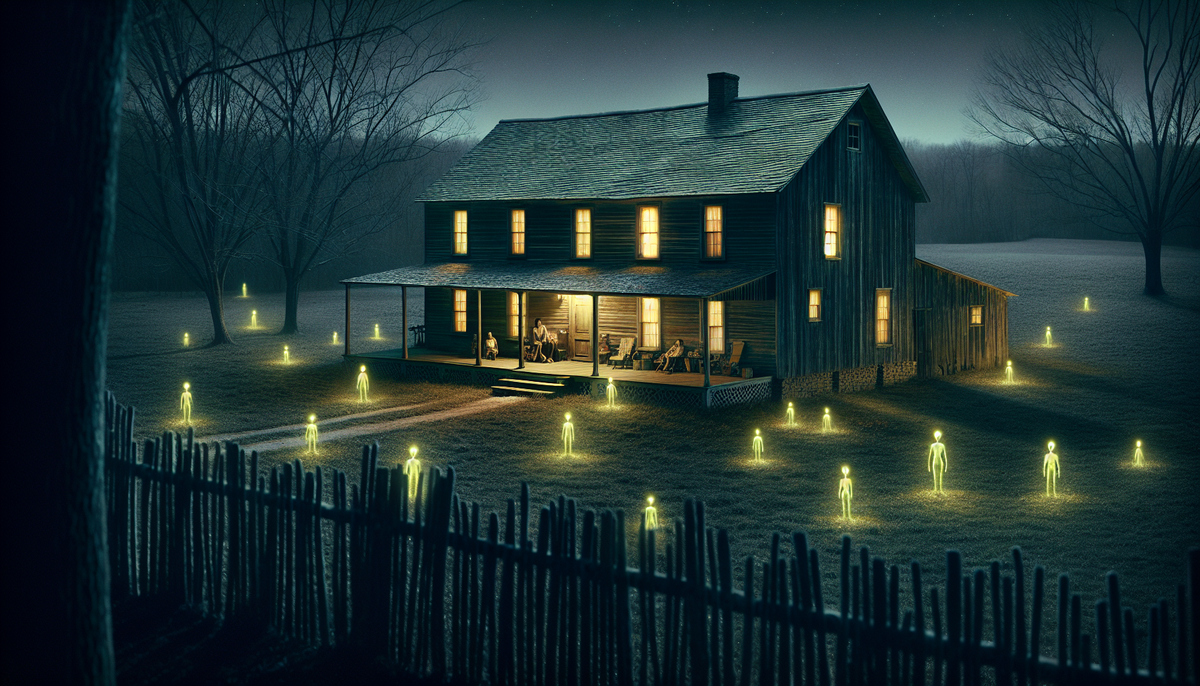
AI visualization based on witness descriptions. This is a dramatization, not a photograph.
CASE IDUAPI-1955-001
DATEAugust 21-22, 1955
LOCATIONKelly, Christian County, Kentucky
COORDINATES36.95°N 87.50°W
CLASSIFICATIONCLOSE-ENCOUNTER-EXPLAINED
EVIDENCE QUALITYLOW
A family claimed small creatures attacked their farmhouse for four hours. Project Blue Book classified the case as a hoax, and investigators identified the "goblins" as great horned owls whose appearance matched witness descriptions.
On the night of August 21, 1955, five adults and seven children from the Sutton and Taylor families arrived at the Hopkinsville, Kentucky police station claiming that small alien creatures had been attacking their farmhouse and that they had been holding them off with gunfire "for nearly four hours."
Police officers, state troopers, and military police from nearby Fort Campbell responded to the farmhouse. Their search found no evidence of creatures, only broken windows and holes in screens consistent with gunfire. Project Blue Book officially classified the case as a HOAX.
Investigators Joe Nickell and Brian Dunning independently concluded that the family had encountered great horned owls, which are nocturnal, fly silently, have glowing yellow eyes, stand about two feet tall, and aggressively defend their nests. The meteor sighting that began the incident was likely a genuine meteor, and the "green light" reported in the woods was consistent with foxfire, a bioluminescent fungus on decaying wood.
Support Independent UAP Research
Get exclusive case analyses, deep‑dive reports, and behind‑the‑scenes updates.
The Kelly-Hopkinsville incident became one of the most famous UFO "close encounter" cases, inspiring the "little green men" trope in popular culture. However, the newspaper account that first used the term actually did not describe the creatures as green; the color was added in later retellings.
The residents of the farmhouse included itinerant carnival workers visiting the family, which some investigators have suggested may be relevant to their storytelling abilities. Officials at the time noted "there was no drinking involved," though psychologists later suggested that stress, excitement, and possible intoxication may have contributed to the sighting.
The case has been used as an academic example of pseudoscience. Psychologists Rodney Schmaltz and Scott Lilienfeld cite it in teaching students to distinguish truth from fiction and develop critical thinking skills about "extraordinary claims."
Timeline
August 21, 1955 - Evening
Sutton farmhouse near Kelly, KY
Billy Ray Taylor claims to see "bright light streak across the sky and disappear beyond a tree line" (likely meteor) [1]
August 21, 1955 - ~19:00
Sutton farmhouse
Family reports small creatures appearing at windows and doorway; Elmer Sutton and Billy Ray Taylor begin shooting at them [2]
August 21, 1955 - ~23:00
Hopkinsville police station
Five adults and seven children arrive claiming creatures attacked farmhouse "for nearly four hours" [2]
August 21-22, 1955 - Night
Sutton farmhouse
Police response: 4 city officers, 5 state troopers, 3 deputies, 4 MP from Fort Campbell. Find only broken windows and bullet holes. [1]
August 22, 1955 - ~03:30
Sutton farmhouse
Families claim creatures returned; they "packed up and left" by morning [2]
August 22, 1955
Hopkinsville
Kentucky New Era publishes first report, increasing creature count to "12 to 15" [2]
Case officially classified as HOAX with no further comment [1]
2006
Skeptical Inquirer
Joe Nickell publishes investigation identifying great horned owls as probable cause [2]
Witness Accounts
Billy Ray TaylorVisitor at Sutton farmhouse; reportedly itinerant carnival worker[Primary witness; interviewed by police and press]
"[Saw] a bright light streak across the sky and disappear beyond a tree line some distance from the house."
Initial meteor sighting that preceded the "siege" [1]
Elmer "Lucky" SuttonResident of farmhouse[Primary witness; interviewed by police and press]
"[Claimed to be] shooting at a few short, dark figures who repeatedly popped up at the doorway or peered into windows."
One of two men who fired weapons at alleged creatures [2]
Police and military responders4 city police, 5 state troopers, 3 deputies, 4 Fort Campbell MPs[Official law enforcement response]
"[Search] yielded no evidence apart from broken windows and holes in screens, possibly the result of gunfire."
Responded to farmhouse; found no evidence of creatures [1]
Evidence Analysis
Scene examination
Police searched farmhouse and surrounding area for evidence of creatures. [1]
Status: Found only broken windows and holes in screens consistent with gunfire. No creature remains, tracks, or other physical evidence.
Documentary
Kentucky New Era newspaper coverage, August 22, 1955. Project Blue Book file. [2]
Status: Contemporary coverage preserved. Blue Book classification: HOAX.
Academic analysis
Schmaltz & Lilienfeld (2014) analysis in Frontiers in Psychology. [4]
Status: Case cited as academic example of pseudoscience for teaching critical thinking. Published in peer-reviewed journal.
Competing Explanations
Great horned owls (Nickell, Dunning, Leclet consensus) [1][2]
Supporting Evidence
Great horned owls are nocturnal, fly silently, have glowing yellow eyes, stand approximately 2 feet tall, and aggressively defend nests. Physical description matches witnesses: "large pointed ears, claw-like hands, glowing yellow eyes, spindly legs." Brian Dunning: "There are simply too many similarities between the creatures reported and an aggressive pair of Great Horned Owls." French UFOlogist Renaud Leclet independently reached same conclusion.
Conflicting Evidence
Witnesses claimed creatures floated and bullets struck them "like hitting a metal bucket." Family maintained their account for decades.
Meteor + foxfire + stress response [1][3]
Supporting Evidence
Initial "light in sky" coincided with known meteor activity. "Green light in woods" consistent with foxfire (bioluminescent fungus). Stress and excitement could cause perceptual distortion. Police found no evidence of creatures.
Conflicting Evidence
Does not fully account for detailed creature descriptions or sustained four-hour "siege."
Hoax or exaggeration (Blue Book classification) [1][2]
Supporting Evidence
Project Blue Book officially classified case as HOAX. Some residents were itinerant carnival workers. No physical evidence of creatures found. Family left area after incident.
Conflicting Evidence
Police noted "no drinking involved." Family appeared genuinely frightened. Multiple witnesses provided consistent (if not identical) accounts.
Genuine extraterrestrial encounter [3][4]
Supporting Evidence
Multiple witnesses over extended period. Family maintained account for years. Duration and intensity of incident were unusual.
Conflicting Evidence
Project Blue Book ruled HOAX. Physical description matches great horned owls. No physical evidence recovered. Meteor and foxfire explain auxiliary phenomena. Case used as academic example of pseudoscience.
Investigation
Investigating Bodies: Hopkinsville Police; Kentucky State Police; Christian County Sheriff; Fort Campbell Military Police; Project Blue Book; CSI (Joe Nickell)
Methods: Immediate police response to farmhouse. Scene examination for evidence. Witness interviews. Blue Book classification. Modern reanalysis by skeptical investigators.
Finding: Police found no evidence of creatures. Project Blue Book classified as HOAX. Nickell and Dunning independently identified great horned owls as probable cause. Meteor and foxfire explain auxiliary phenomena.
Conclusion: EXPLAINED: The "Kelly-Hopkinsville Goblins" were most likely great horned owls, whose physical appearance and behavior closely match witness descriptions. The case was officially classified as a HOAX and is used academically to teach critical thinking about extraordinary claims. [1][2][4]
SOURCE LOG
[1]Dunning, Brian. "Skeptoid #331: The Kelly-Hopkinsville Encounter." Skeptoid podcast, October 9, 2012.[secondary]
[2]Nickell, Joe. "Siege of Little Green Men: The 1955 Kelly, Kentucky, Incident." Skeptical Inquirer, Vol. 30, No. 6, November-December 2006.[secondary]
[3]Kentucky New Era. "Story of Space-ship, 12 Little Men Probed Today." August 22, 1955.[primary]
[4]Schmaltz, Rodney; Lilienfeld, Scott O. "Hauntings, homeopathy, and the Hopkinsville Goblins: using pseudoscience to teach scientific thinking." Frontiers in Psychology, Vol. 5, Article 336, April 17, 2014.[primary]
[6]Leclet, Renaud. "Que cache les entités de Kelly-Hopkinsville?" Plaquette du Cnegu, 2008.[secondary]
Editorial Note: The Kelly-Hopkinsville "Goblin Siege" has been EXPLAINED. Project Blue Book classified it as a HOAX. Independent investigators (Nickell, Dunning, Leclet) concluded the "creatures" were great horned owls, whose physical characteristics closely match witness descriptions. The case is now used academically to teach critical thinking about extraordinary claims. While the incident became culturally significant, inspiring films like "Critters" and the "little green men" trope, the evidence strongly supports the owl hypothesis.