Hull 1801: The Moon Orb Over the Humber
Multiple witnesses observed an "immense moon with a black bar across it" hovering over the Humber River at midnight, which transformed into multiple luminous globes and bathed the city in blue light, documented in contemporary newspapers.
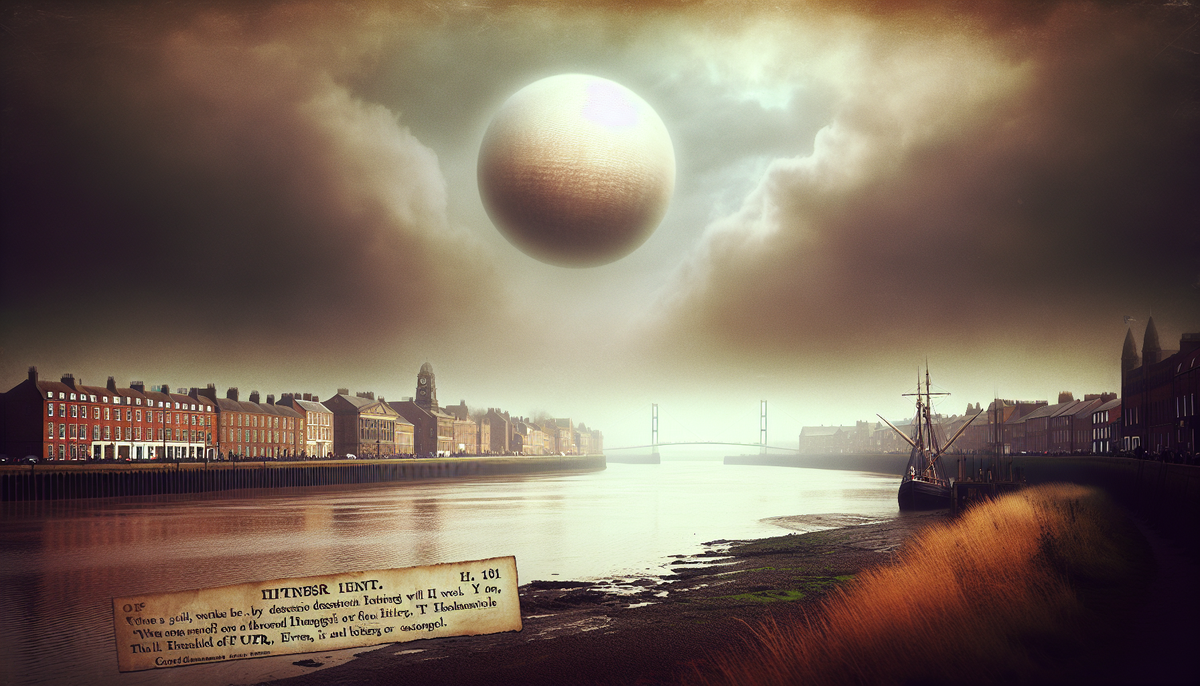
On the night of June 19, 1801, residents of Hull, England witnessed an extraordinary aerial phenomenon over the Humber River. Contemporary newspaper accounts describe "an immense moon with a black bar across it" that appeared at midnight and underwent dramatic transformations over an extended period.
According to a report published in the Northampton Mercury on July 11, 1801: "It seemed then to form itself into seven small distinct moons or globes of fire which disappeared for the space of a few seconds. Its reappearance was equally brilliant, at first showing itself like the face of the moon, afterwards in five circular balls, and lastly like several small stars which gradually faded away, leaving the whole atmosphere brilliantly illuminated."
The Chester Chronicle of July 17, 1801 added: "During the time of it being visible, a faint blue light fell upon the surrounding objects, like that of distant torches." The phenomenon was significant enough to be reported in multiple regional newspapers and later referenced in science periodicals of the era. Modern historian Mike Covell rediscovered these accounts in 2015 while researching archival newspapers.
Support Independent UAP Research
Get exclusive case analyses, deep‑dive reports, and behind‑the‑scenes updates.
Subscribe on Gumroad ($5/month)Historical Context
Hull (Kingston upon Hull) was a major port city in 1801, located at the confluence of the River Hull and the Humber estuary. The city had a population of approximately 30,000 and was an important center for maritime trade. The Humber River over which the phenomenon was observed is a large tidal estuary on England's east coast.
The year 1801 fell during the Napoleonic Wars, and Hull's strategic importance as a port meant significant maritime and military activity in the region. However, the described phenomenon bears no resemblance to any known military technology of the era. Balloon flight existed by this time (the first manned balloon flight occurred in 1783), but no balloon could produce the described luminous effects or transformations.
The early 19th century marked a transitional period between religious and scientific explanations of unusual phenomena. Unlike medieval accounts that attributed aerial anomalies to divine signs, Regency-era newspapers attempted more observational descriptions. The multiple newspaper reports suggest the phenomenon was witnessed by numerous people and considered noteworthy by contemporary editors.
Timeline
Witness Accounts
"[Observed] an immense moon with a black bar across it [which] seemed then to form itself into seven small distinct moons or globes of fire."
"During the time of it being visible, a faint blue light fell upon the surrounding objects, like that of distant torches."
Documentary Evidence
Competing Explanations
Ball lightning or atmospheric electrical phenomenon [4]
The luminous appearance, transformations, and blue light are consistent with some ball lightning reports. Atmospheric electrical phenomena can persist for extended periods and appear to change shape. The location over water (Humber estuary) could facilitate unusual electrical conditions.
Ball lightning typically does not persist as long as described or undergo the complex sequential transformations reported. The enormous apparent size ("immense moon") exceeds typical ball lightning dimensions.
Auroral display or unusual atmospheric optics [4]
Aurora borealis can appear at Hull latitude during periods of strong solar activity. Auroral displays can produce colored lights, transformations, and illuminate surroundings. June would have short nights, making any aurora particularly visible.
The specific structured appearance ("black bar across it," distinct "globes") is atypical for auroral displays. Witnesses compared it to the moon, suggesting a discrete object rather than diffuse lights.
Meteor or bolide with unusual characteristics [4]
Bolides (exploding meteors) can produce dramatic luminous effects and fragment into multiple pieces. Some meteor events produce blue-green illumination.
The duration (extended observation period) and hovering behavior are inconsistent with meteor characteristics. Meteors do not hover or reappear after disappearing.
Unidentified aerial phenomenon [3][4]
The structured appearance, extended duration, transformations between distinct shapes, and hovering behavior are anomalous for known natural phenomena. Multiple independent newspapers reported the event, suggesting multiple witnesses. The "black bar" feature suggests structure.
No physical evidence beyond newspaper reports. The phenomenon occurred over 200 years ago, limiting investigation possibilities.