Green Fireballs 1948-1949: The Nuclear Installation Mystery
Numerous green fireball sightings over sensitive nuclear installations prompted high-level scientific conferences, official investigation by Project Twinkle, and concern about possible foreign radiological warfare experiments.
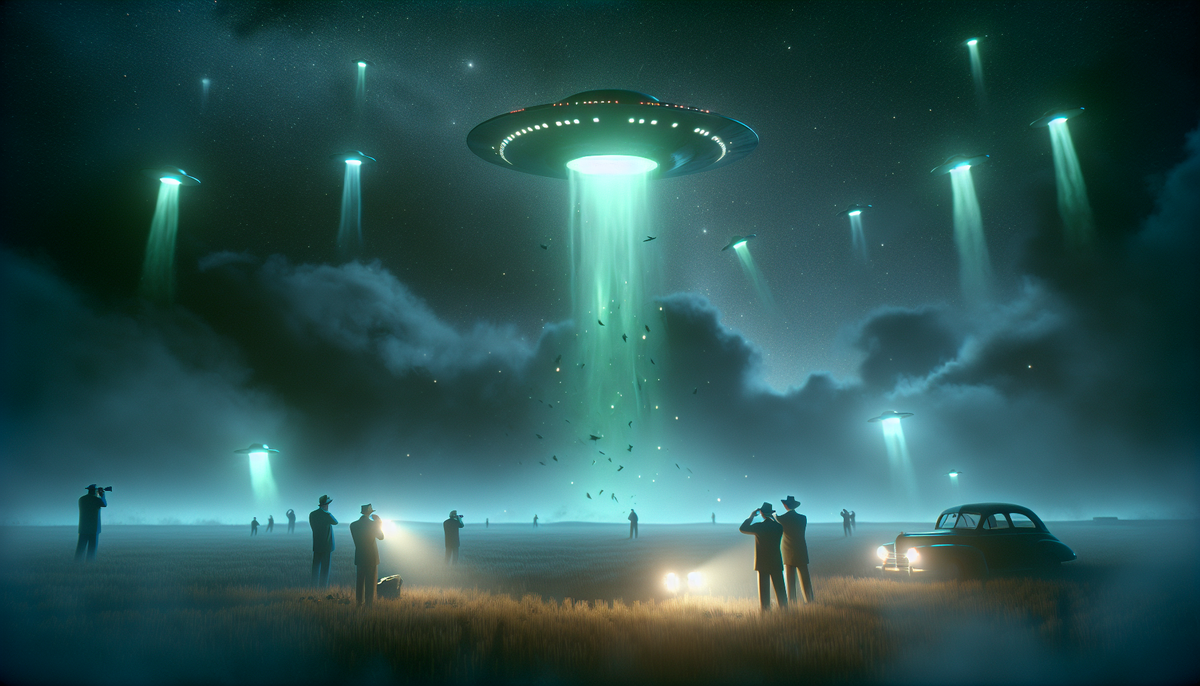
AI visualization based on witness descriptions. This is a dramatization, not a photograph.
CASE IDUAPI-1948-001
DATEDecember 1948 - 1951
LOCATIONNew Mexico (Los Alamos, Sandia, White Sands)
COORDINATES35.88°N 106.31°W (Los Alamos)
CLASSIFICATIONVISUAL-MULTIPLE-WITNESS-SCIENTIFIC
EVIDENCE QUALITYHIGH
Numerous green fireball sightings over sensitive nuclear installations prompted high-level scientific conferences, official investigation by Project Twinkle, and concern about possible foreign radiological warfare experiments.
Beginning in late 1948, numerous bright green fireballs were observed over sensitive nuclear installations in New Mexico, including Los Alamos, Sandia Base, and White Sands Proving Grounds. The sightings prompted official concern about possible foreign radiological warfare experiments and led to a February 1949 conference at Los Alamos attended by Project Sign investigators, top scientists including Edward Teller, and military personnel.
Dr. Lincoln La Paz, a meteor expert from the University of New Mexico, was brought in to investigate and concluded that the observed objects were "atypical of meteors." In January 1949, the Director of Army Intelligence wrote that the fireballs "may be the result of radiological warfare experiments by a foreign power" and that they were "of such great importance, especially as they are occurring in the vicinity of sensitive installations."
The Air Force established Project Twinkle in December 1949 to study the phenomenon, deploying observation and photographic units. However, the project was never fully implemented and was discontinued in 1951 with an inconclusive official finding that the phenomena were "likely natural in origin." The case remains contested, with skeptics favoring the meteor explanation and researchers noting the atypical characteristics documented by scientific observers.
Support Independent UAP Research
Get exclusive case analyses, deep‑dive reports, and behind‑the‑scenes updates.
The green fireball sightings occurred during the height of early Cold War nuclear development. New Mexico was home to the nation's most sensitive nuclear facilities: Los Alamos (birthplace of the atomic bomb), Sandia Base (nuclear weapons assembly), and White Sands Proving Grounds (missile testing). Any unexplained aerial phenomena over these installations raised immediate national security concerns.
The context of potential Soviet espionage and the recent development of Soviet nuclear capability (the USSR would test its first atomic bomb in August 1949) made military officials particularly concerned about unexplained objects in restricted airspace. This explains why meteor expert Dr. Lincoln La Paz was brought in and why high-level scientific conferences were convened.
Natural green meteors do exist, caused by copper or magnesium content. However, La Paz and other observers noted that the green fireballs exhibited characteristics inconsistent with natural meteors, including horizontal trajectories, lack of fragmentation, and absence of recovered meteorite fragments despite intensive ground searches.
Timeline
December 5, 1948 - Night
New Mexico
Two plane crews (one civilian, one military) independently report bright "green ball of fire" and object "like a huge green meteor" [1]
December 8, 1948
New Mexico
Two pilots report another green fireball observation [2]
December 20, 1948
Albuquerque, New Mexico
Dr. Lincoln La Paz writes to USAF stating observed objects are "atypical of meteors" [3]
January 13, 1949
Fourth Army HQ, Texas
Director of Army Intelligence writes that fireballs "may be the result of radiological warfare experiments by a foreign power" and occur "in the vicinity of sensitive installations" [2]
February 1949
Los Alamos, New Mexico
High-level conference attended by Project Sign, Joseph Kaplan, Edward Teller, and military personnel. Unable to identify origin of green fireballs. [1]
May 1949
Alamogordo, New Mexico
UFO skeptic Dr. Donald Menzel observes green fireball; privately states meteor explanation inadequate; later publicly attributes to meteor [4]
December 1949
New Mexico
Project Twinkle established: network of green fireball observation and photographic units [1]
1951
New Mexico
Project Twinkle discontinued with inconclusive official conclusion that phenomena were "likely natural in origin" [1]
Witness Accounts
Civilian and Military Plane CrewsTwo crews (one civilian, one military) on night of December 5, 1948[Reports filed with USAF; documented by Ruppelt]
"[Observed] a bright green ball of fire... like a huge green meteor."
Initial reports that triggered official concern [1]
Dr. Lincoln La PazAstronomer, University of New Mexico; Director, Institute of Meteoritics[Official USAF consultant on case; correspondence preserved]
"[The objects were] atypical of meteors."
Expert meteor specialist brought in by USAF to investigate [3]
Dr. Donald MenzelHarvard astrophysicist, noted UFO skeptic[Observation documented; private letter cited at Air Force SAB meeting November 1949]
"Circumstances force me to conclude that the phenomena described are actually real. I merely raise the question as to why the phenomenon seems to be confined to the Alamogordo region."
Private 1949 statement contradicts later public dismissal as meteor [4]
Dr. Edward TellerTheoretical physicist, "father of the hydrogen bomb"[Attended February 1949 Los Alamos conference]
"[Conference was] unable to identify origin of observed green fireballs."
Participated in high-level scientific review [1]
Documentary Evidence
Documentary
Project Twinkle records and final report (1951). Official USAF investigation documentation. [1]
Status: Available through Project 1947 archives. Conclusion: "likely natural in origin" but inconclusive.
Documentary
Los Alamos conference transcript, February 1949. Record of scientific deliberations. [5]
Status: Preserved; transcript available through Project 1947.
Documentary
Fourth Army Intelligence communication, January 13, 1949. States concern about "radiological warfare experiments." [2]
Status: Available through Project 1947 archives.
Documentary
Dr. La Paz correspondence to USAF, December 20, 1948. Expert assessment that objects were atypical of meteors. [3]
Status: Referenced in multiple sources; correspondence preserved.
Green meteors are known to occur due to copper or magnesium content. The official Project Twinkle conclusion was that the phenomena were "likely natural in origin." Dr. Menzel later attributed his sighting to a meteor.
Conflicting Evidence
Dr. La Paz, a meteor expert, stated the objects were "atypical of meteors." Characteristics included horizontal trajectories, consistent green color throughout flight, lack of fragmentation, and no recovered fragments despite ground searches. Menzel privately stated in 1949 that the meteor explanation was inadequate.
Foreign radiological warfare experiments [2]
Supporting Evidence
Official military concern expressed in January 1949 intelligence communication. Sightings concentrated over sensitive nuclear installations. Timing coincided with Cold War espionage concerns and Soviet nuclear development.
Conflicting Evidence
No evidence of foreign technology capable of producing such phenomena. No Soviet or other foreign confirmation. The phenomena continued after Soviet nuclear capability was established, suggesting alternative origins.
Sequelae of US atomic weapons tests [1]
Supporting Evidence
New Mexico hosted extensive nuclear testing. Some theories suggested fallout clouds or other nuclear-related atmospheric phenomena.
Conflicting Evidence
The consistent appearance of discrete, fast-moving objects does not match fallout cloud characteristics. Tests were not occurring during all sighting periods.
Unidentified aerial phenomena of unknown origin [1][3]
Supporting Evidence
La Paz documentation of atypical characteristics. High-level scientific investigation unable to reach conclusion. Project Twinkle ended inconclusively rather than definitively resolving the matter. Pattern of sightings specifically over sensitive installations.
Conflicting Evidence
No physical evidence recovered. Green meteors are known natural phenomena. Official position favors natural explanation.
Official Investigation
Investigating Bodies:USAF Project Sign; Project Twinkle; Los Alamos Scientific Advisory Board; Fourth Army Intelligence
Methods: Multiple high-level scientific conferences. Expert meteor analysis by Dr. La Paz. Deployment of observation and photographic units. Ground searches for meteorite fragments. Intelligence assessment of foreign threat possibility.
Finding: February 1949 Los Alamos conference unable to identify origin. Dr. La Paz concluded objects atypical of meteors. Project Twinkle officially concluded phenomena "likely natural in origin" but investigation was never fully implemented.
Conclusion: The green fireball phenomenon remains officially unresolved. While the final assessment favored natural explanations, the investigation was incomplete and expert witnesses documented characteristics inconsistent with natural meteors. [1][2][3]
Ongoing Debate: Skeptics emphasize meteor explanation and official conclusion; researchers cite La Paz documentation and incomplete investigation; historians note concentration of sightings over nuclear installations
SOURCE LOG
[1]Ruppelt, Edward J. "The Report on Unidentified Flying Objects." Chapter 4. 1956. Project Gutenberg.[primary]
[3]Randle, Kevin D. "The Government UFO Files: The Conspiracy of Cover-Up." Visible Ink Press, 2014. La Paz correspondence.[secondary]
[4]Menzel letter, May 16, 1949. Cited at Air Force Scientific Advisory Board meeting, November 3, 1949.[primary]
[5]Los Alamos conference transcript, February 1949. Available via Project 1947.[primary]
[6]Clark, Jerome. "The UFO Book: Encyclopedia of the Extraterrestrial." Visible Ink Press, 1998.[secondary]
Editorial Note: The green fireball phenomenon received extensive official investigation including Project Twinkle and high-level scientific conferences involving figures like Edward Teller. Dr. Lincoln La Paz, a meteor expert, documented characteristics inconsistent with natural meteors. The concentration of sightings over nuclear installations raised national security concerns. While officially attributed to natural causes, the investigation was incomplete and expert witnesses documented anomalous characteristics. Primary source documents including conference transcripts and intelligence communications are preserved and accessible.