
Florence 1954 UFO Sighting

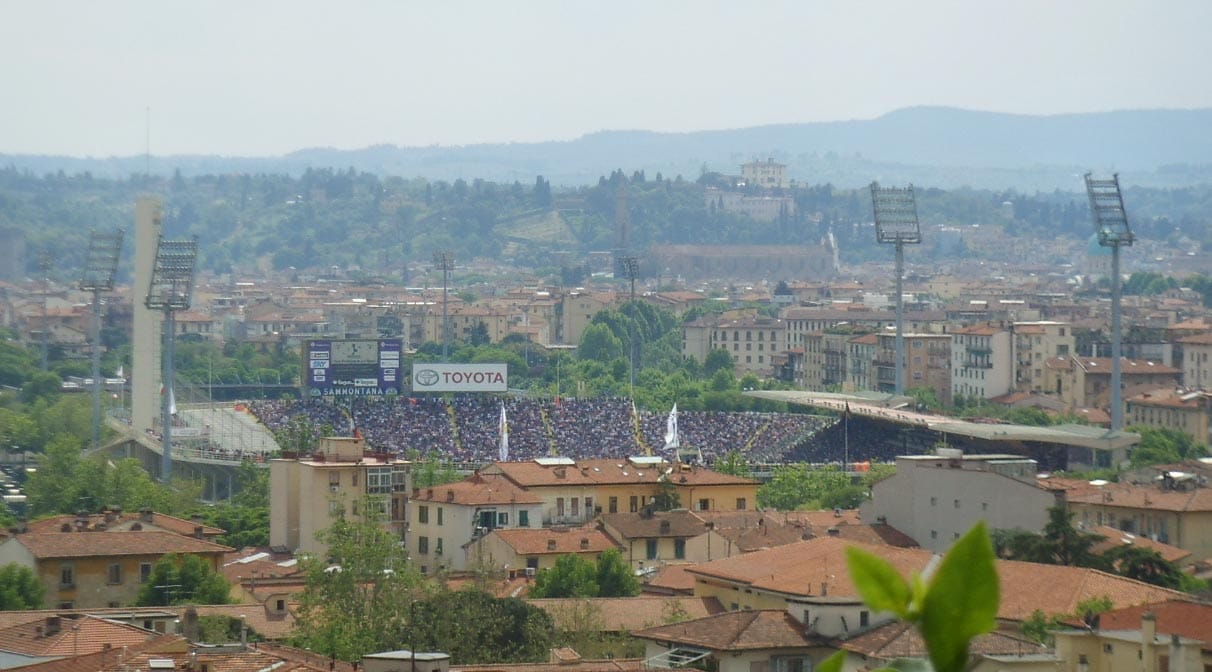
During a mid-afternoon fixture at the Stadio Artemio Franchi, multiple anomalous aerial objects traversed the airspace above the city in broad daylight. The objects were observed by thousands of independent witnesses including professional athletes, match officials, journalists, and ordinary citizens scattered across Florence and the surrounding Tuscan countryside.
What elevates this case above folklore is physical evidence. As the objects departed, they deposited a fibrous, silver material across the stadium, the city, and the surrounding forests. This substance, collected under controlled conditions by journalist Giorgio Batini and delivered to the University of Florence, was subjected to formal spectrographic analysis. The results were conclusive and damning to conventional explanation: the material was inorganic, composed of boron, silicon, calcium, and magnesium. Spider silk, the standard skeptical explanation, is an organic protein. It contains none of those elements.
Seven decades later, the chemical analysis has not been refuted. The trace material has not been re-identified. The Florence event remains one of the most forensically documented UAP incidents in European history, and its core evidential challenge stands unanswered.
1. Context: The 1954 European Aerial Wave
The Florence incident did not occur in isolation. The autumn of 1954 represents the single highest-density period of documented anomalous aerial sightings in European post-war history. Between September and November 1954, France alone recorded over 600 reported sightings. The Italian peninsula experienced a parallel surge, with reports clustering heavily over Tuscany and the Po Valley.
On September 10, 1954, six weeks before the Florence event, the city of Oloron-Sainte-Marie in southwestern France documented a nearly identical sequence: multiple aerial objects traversing the sky, followed by the deposition of a filamentous white substance that sublimated rapidly on contact with the ground or human skin. The Oloron event is the documented forensic precedent to Florence.
The Fiorentina vs. Pistoiese fixture on October 27 was a mid-afternoon friendly, with Fiorentina leading 6–2 in the second half at the time of the incident. The Stadio Artemio Franchi, designed by Pier Luigi Nervi and opened in 1931, was a landmark of Italian modernist architecture with capacity for the estimated crowd. Weather on the day was clear, with a crisp, cloudless autumn sky providing optimal visibility conditions.
2. Incident Timeline: October 27, 1954
3. Eyewitness Testimony
The Florence event is distinguished by the quality as well as the quantity of its witnesses. Among the 10,000 present at the stadium were professional athletes whose occupations require precise spatial awareness and the ability to track fast-moving objects. Their accounts are treated here as high-value testimony. All three witnesses named below are documented historical figures whose presence at the October 27 match is verifiable through Italian football records.
Boni's description — objects "moving very fast and then they just stopped" — aligns with what modern AARO documentation classifies as Signature 2 kinematic behavior: instantaneous velocity arrest without observable deceleration. This characteristic requires either the absence of inertia or a propulsion mechanism that decouples the craft from the inertial reference frame of the surrounding medium. Neither conventional aerodynamics nor any known natural atmospheric phenomenon produces this signature.
4. The Angel Hair Trace Evidence
The term "angel hair" was applied to this category of material following the 1952 Oloron, France event, which constitutes the documented forensic precedent. The Florence material shares all reported physical characteristics of the Oloron sample.
5. Forensic Chemical Analysis — University of Florence, 1954
Professor Giovanni Canneri, Director of the Institute of Chemical Analysis at the University of Florence, conducted the primary laboratory examination of the collected samples using mid-century microchemical and elemental spectrographic methods. The analysis was completed before the material fully degraded, and the findings were formally reported.
| Element | Detection | Significance | Spider Silk Equivalent |
|---|---|---|---|
| Boron (B) | CONFIRMED | Key constituent of borosilicate glass. Acutely toxic to arachnids — cannot be synthesized by spiders. | ABSENT |
| Silicon (Si) | CONFIRMED | Primary component of silica-based glass structures. Not found in organic protein filaments. | ABSENT |
| Calcium (Ca) | CONFIRMED | Present in combination with B and Si; consistent with borosilicate glass matrix. | Trace only |
| Magnesium (Mg) | CONFIRMED | Additional inorganic component. Combined elemental profile matches no known natural atmospheric process. | Trace only |
| Radioactivity | NON-RADIOACTIVE | Geiger counter: negative. Rules out nuclear or radiological explanations. | N/A |
| Organic Proteins | ABSENT | No biological protein matrix detected. Directly contradicts spider silk hypothesis, which requires C, H, N, O compounds. | PRIMARY component |
Based on these findings, Professor Canneri formally hypothesized that the material was a form of macromolecular "borosilicate glass" — an inorganic compound structurally similar to manufactured Pyrex glass, but extruded into fine, atmospherically suspended filaments by an unknown mechanism. No aircraft, weather system, or biological organism known to 1954 aerospace science was capable of producing this material at altitude.
6. The Spider Migration Hypothesis: Claim and Refutation
The dominant skeptical explanation, advanced most prominently by U.S. Air Force pilot and astronomer James McGaha, attributes the incident to the autumn migration of ballooning spiders — specifically members of the Linyphiidae family, which migrate by extruding silk into wind currents. McGaha has proposed either that the "craft" were optical illusions caused by sunlight on massed spider silk, or that a fragmenting meteor created both the visual display and the material deposit.
- ›The fibrous material was spider silk from ballooning Linyphiidae
- ›The aerial objects were optical illusions from reflected sunlight on silk
- ›Rapid material disappearance is consistent with spider silk dispersal
- ›The autumn timing aligns with arachnid migration season
- ✗Spider silk is organic protein: C, H, N, O. Canneri found B, Si, Ca, Mg. Zero chemical overlap.
- ✗Boron is acutely toxic to arachnids and cannot be biologically synthesized by them.
- ✗10,000 witnesses independently reported structured craft with defined morphology — not diffuse light patterns.
- ✗Objects demonstrated corroborated kinematic behaviors inconsistent with any atmospheric phenomenon.
Roberto Pinotti, aerospace scholar and president of Italy's Centro Ufologico Nazionale (CUN), summarizes the fatal flaw: spider silk does not contain boron or silicon, boron is highly toxic to arachnids, and therefore a biological spider cannot organically synthesize or extrude a boron-rich material. The skeptical hypothesis fails at the chemistry level, independently of the witness testimony.
7. Historical Significance and Open Questions
The October 27, 1954 Florence event holds a specific position in UAP evidentiary history for three compounding reasons: the scale of independent witness corroboration, the successful emergency collection of physical trace material, and the formal laboratory analysis that produced a falsifiable chemical profile.
Most UAP incidents collapse under examination because they rest on witness testimony alone. Florence does not. The Canneri analysis produces a specific, testable claim: the material was an inorganic borosilicate compound. That claim can be confirmed, contested, or refined by any competent laboratory with access to the original sample documentation. The tragedy of this case is that the samples themselves are gone. The physical evidence window closed within hours.
What remains are the documented findings. And those findings have not been explained away in seven decades of attempting to do so.
| Source | Type | Classification | Validation | Notes |
|---|---|---|---|---|
| La Nazione (Florence), Oct 27–28, 1954. Batini byline. | Primary press | Public / Archival | CONFIRMED | Original Italian-language reporting. Accessible via Biblioteca Nazionale Centrale di Firenze archives. |
| Prof. Giovanni Canneri, Institute of Chemical Analysis, University of Florence. Spectrographic analysis, 1954. | Academic / Lab | Institutional | NEEDS ARCHIVAL | Findings widely cited. Original documentation requires archival request to University of Florence. |
| Ardico Magnini eyewitness account. Multiple recorded interviews. | Eyewitness | Public record | CONFIRMED | Magnini verifiable via Italian football records. Account in Italian sports press and subsequent documentation. |
| Gigi Boni eyewitness account. | Eyewitness | Public record | CONFIRMED | Documented in Italian and international sources including documentary interviews. |
| Romolo Tuci eyewitness account. | Eyewitness | Public record | CONFIRMED | Pistoiese team member. Account documented in contemporary Italian reporting. |
| Roberto Pinotti, CUN. Chemical counter-analysis of spider silk hypothesis. | Scientific critique | Published | CONFIRMED | Boron toxicity argument is independently verifiable against standard arachnid biology literature. |
| James McGaha. Skeptical spider migration hypothesis. | Skeptical analysis | Published | CONFIRMED | Included for completeness. Chemical rebuttal stands independent of this source. |
| Oloron-Sainte-Marie angel hair incident, September 10, 1952 (precursor case). | Comparative case | Public record | CONFIRMED | French press archives confirm date and witness accounts. |
| Match referee official log, Fiorentina vs. Pistoiese, October 27, 1954. | Official record | FIGC archives | NEEDS ARCHIVAL | Match suspension widely cited. Original match report requires FIGC archive access. |
- Mass witness event occurred October 27, 1954 at Stadio Artemio Franchi
- Match formally suspended mid-play due to aerial objects
- Physical trace material deposited across Florence and surrounding area
- Batini collected sample via controlled, skin-contact-free method
- University of Florence conducted spectrographic analysis
- Canneri findings: inorganic elemental composition (B, Si, Ca, Mg)
- No radioactivity detected in collected samples
- Material sublimated completely within hours of deposition
- Spider silk is chemically incompatible with Canneri's elemental findings
- Boron is acutely toxic to arachnids and cannot be biologically synthesized by them
- Exact number of witnesses (estimates range 10,000 to 15,000+)
- Precise object count (descriptions range from 2 to several dozen)
- Whether McGaha's meteor fragmentation theory could account for both visual display and material deposit simultaneously
- Whether the Oloron material and Florence material were chemically identical
- Purity of Canneri's sample given the brief window between deposition and collection
- Origin and mechanism of material production at altitude
- Nature and propulsion of observed aerial objects
- Whether original Canneri analysis documentation survives in University of Florence archives
- Whether any Italian government or military records from October 27 exist
- Connection between Florence event and broader 1954 European wave
- Whether the borosilicate glass hypothesis has been tested against modern standards
The evidentiary core of the Florence 1954 event — the Canneri spectrographic analysis — has not been refuted. The trace material has not been re-identified. The skeptical explanation fails at the chemistry level. This investigation remains open pending archival access to the original University of Florence laboratory documentation and the Italian FA official match record. Any researcher with access to either archive is encouraged to contact UAPI directly.