
Byland Abbey 1290 Silvery Disc
A chronicle from Byland Abbey records that Abbot Henry and the monks observed a "large round silver thing like a disc" fly over the abbey, causing great terror among the witnesses.
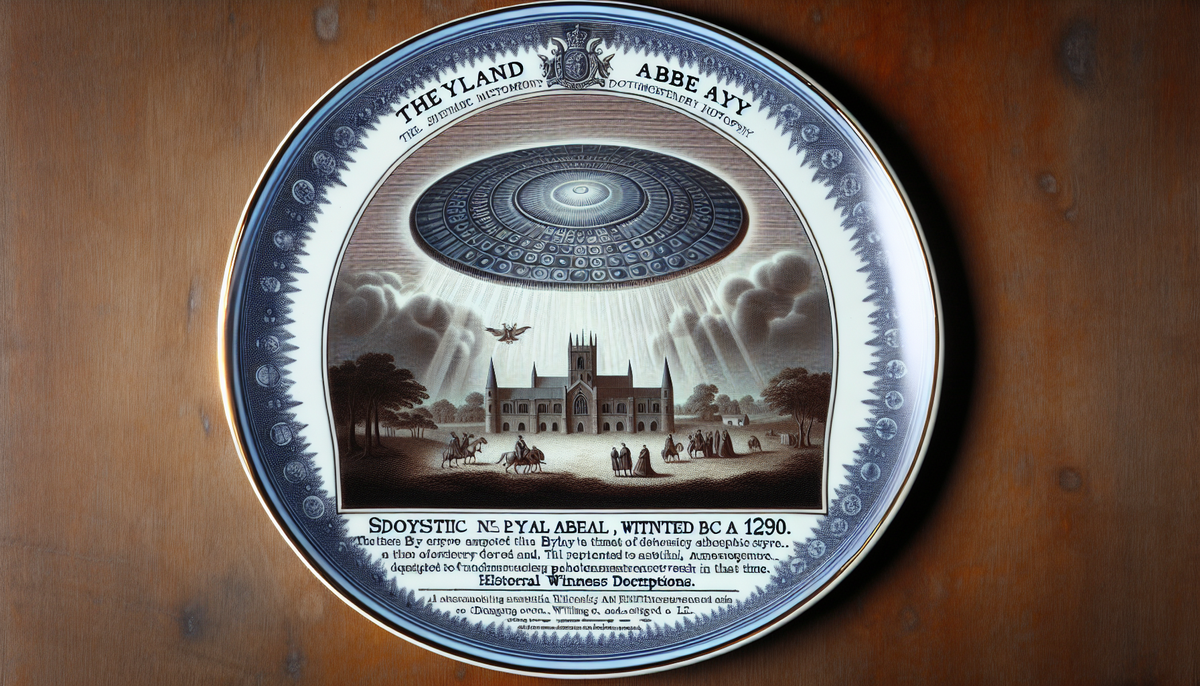
A medieval chronicle from Byland Abbey in North Yorkshire, England, preserved in British Library manuscript Lansdowne 894, records an unusual aerial observation from 1290 AD. The account states that Abbot Henry and the monks of the abbey witnessed a "large round silver thing like a disc" (translated from Latin) fly over the monastery.
The chronicle describes the object's appearance in specific terms: large, round, silver in color, and disc-shaped. The account further records that the sight caused "great terror" among the monks who witnessed it. This level of specific detail, including the named witness (Abbot Henry) and the emotional response, distinguishes the account from more vague medieval references to lights or signs in the sky.
The manuscript is held in the British Library's Lansdowne collection, established by William Petty, 1st Marquess of Lansdowne, in the 18th century. The medieval chronicle itself dates to the period of the reported event. The account has been translated and analyzed by multiple scholars, though interpretation of what the monks actually observed remains debated.
Historical Context
Byland Abbey was a Cistercian monastery founded in 1135 in North Yorkshire. By 1290, it was an established religious house with a functioning scriptorium where chronicles and records were maintained. The Cistercian order emphasized precise record-keeping, and abbey chronicles from this period are generally considered reliable historical sources for local events.
Medieval chroniclers recorded unusual celestial events as a matter of course, viewing them as potential divine signs or portents. However, the Byland account is notable for its descriptive specificity. Rather than describing a generic "sign in the heavens" or "star," the chronicle uses concrete physical descriptors: round, silver, disc-like. This suggests the chronicler was attempting to describe an observed object rather than recording a conventional prodigy.
The late 13th century was a period of relative stability in England under Edward I. Byland Abbey, though it would later suffer during Scottish raids and the Dissolution, was at this time a prosperous monastery with educated monks capable of producing detailed written records.
Timeline
Witness Accounts
"[Witnessed] a large round silver thing like a disc fly slowly over them and excite the greatest terror."
"[No separate quote; described as sharing the observation and terror response]"
Documentary Evidence
Competing Explanations
Observation of unexplained aerial phenomenon [2][4]
The specific physical description (round, silver, disc-shaped) suggests observation of a structured object. The named witness (Abbot Henry) and recorded emotional response (terror) indicate a significant and unusual event. Cistercian chroniclers were trained in precise observation and recording.
No independent corroboration from other contemporary sources. Medieval observers lacked scientific framework for atmospheric phenomena. The account survives in only one manuscript tradition.
Meteor, bolide, or atmospheric entry event [4]
Large meteors can appear as bright, round, silver objects. Bolides (exploding meteors) can display disc-like appearances due to atmospheric compression. The terror response is consistent with witnessing a dramatic meteor event.
The description emphasizes sustained observation ("flying over") rather than brief streak. "Disc" shape is unusual for meteor descriptions, which typically emphasize linear movement. No associated sound (explosion, rumble) is recorded.
Unusual atmospheric optical phenomenon [4]
Sundogs, ice halos, and other atmospheric optics can produce circular, silvery appearances. Lenticular clouds can appear disc-shaped and metallic. Medieval observers would lack vocabulary for such phenomena.
The account describes movement ("fly over") inconsistent with static atmospheric effects. The specificity of "disc" rather than halo or ring suggests a discrete object. The terror response suggests something more dramatic than unusual clouds.
Embellished or miscopied chronicle entry [3][4]
Medieval manuscripts were hand-copied, introducing potential errors. Chroniclers sometimes embellished accounts for dramatic effect. The story may have grown in the telling before being recorded.
Cistercian chronicles are generally considered reliable for contemporary events. The specific, mundane details (Abbot Henry named, specific emotional response) suggest eyewitness basis rather than literary invention.