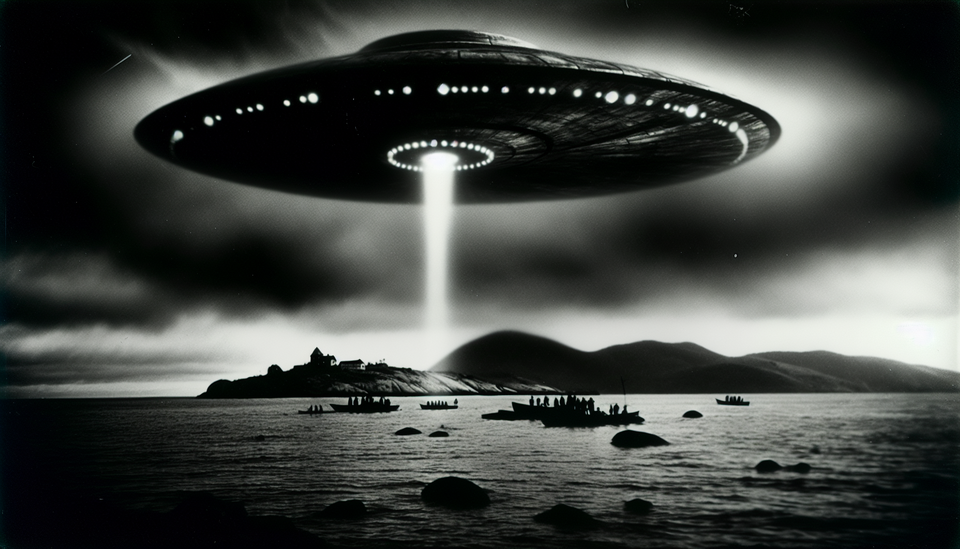
Boston 1639: America's First Documented UFO Sighting
Governor John Winthrop recorded America's first documented UFO sighting in 1639: a "great light" over Muddy River observed by "sober, discreet" witnesses for 2-3 hours.
In March 1639, Governor John Winthrop of the Massachusetts Bay Colony recorded in his personal journal an unusual sighting reported by James Everell, described as "a sober, discreet man." According to Winthrop's account, Everell and two companions were traveling in a boat on the Muddy River (modern Brookline area) when they observed a "great light" in the night sky.
The light reportedly behaved in an unusual manner: it "stood still," then "ran swiftly," then stood still again. Over the course of two to three hours of observation, the object appeared to "contract into the figure of a swine" and spread out again. When the experience ended, the witnesses found that their boat had moved approximately a mile upstream against the current, though they had no memory of this movement.
Winthrop's journal is a primary historical source held at the Massachusetts Historical Society. Winthrop was not a witness himself but recorded the account from Everell. The journal entry represents one of the earliest documented anomalous aerial observations in North American colonial records.
Support Independent UAP Research
Get exclusive case analyses, deep‑dive reports, and behind‑the‑scenes updates.
Subscribe on Gumroad ($5/month)Historical Context
The Massachusetts Bay Colony in 1639 was a Puritan settlement less than a decade old. Governor John Winthrop maintained a detailed journal of colonial life, which has become an invaluable primary source for early American history. Winthrop's journal covers the period from 1630 to 1649.
James Everell is documented in colonial records as a respectable citizen; Winthrop's description of him as "sober, discreet" indicates his testimony was considered credible. The Muddy River was a waterway in the area that would become Brookline, Massachusetts.
The Puritan worldview interpreted unusual phenomena through a religious lens, typically as divine signs or demonic manifestations. However, Winthrop's account is notably restrained, presenting the observation without explicit theological interpretation.
Timeline
Witness Accounts
"[Observed] a great light in the night at Muddy River. When it stood still, it flamed up, and was about three yards square; when it ran, it was contracted into the figure of a swine."
"[Also observed the phenomenon per Winthrop account]"
Documentary Evidence
Competing Explanations
Observation of unexplained aerial phenomenon [1][3]
Winthrop recorded the account from a witness he considered credible. The detailed behavioral description (movement patterns, shape changes) suggests actual observation. The duration (2-3 hours) indicates sustained phenomenon.
Account is secondhand (Winthrop recording Everell). No independent corroboration of this specific incident. 17th century observers lacked scientific framework.
Atmospheric or meteorological phenomenon [3]
Ball lightning, St. Elmo's fire, or unusual atmospheric conditions could produce luminous effects. Marsh gas (will-o'-wisp) was present in the area.
The described behavior (stopping, running swiftly, shape-changing over hours) does not match known atmospheric phenomena. The "swine" shape is highly unusual.
Misperception or exaggeration [3]
Night observation over water is prone to optical illusions. Memory reconstruction could embellish details. The "missing time" element is common in suggestible states.
Winthrop vouched for Everell's credibility. Multiple witnesses present. The specific details suggest attempted accurate description rather than invention.
Spiritual or supernatural interpretation (period context) [1]
Puritans expected divine signs. The "swine" imagery has biblical associations (demons into swine). The account could reflect religious expectations.
Winthrop presents the account without explicit religious interpretation. The description is observational rather than theological. Other Winthrop entries clearly mark religious interpretation when intended.