Basel 1566 Black Spheres
A contemporary illustrated broadsheet depicts numerous black spheres appearing around the sun at dawn over Basel, witnessed by the city population just five years after the similar Nuremberg incident.
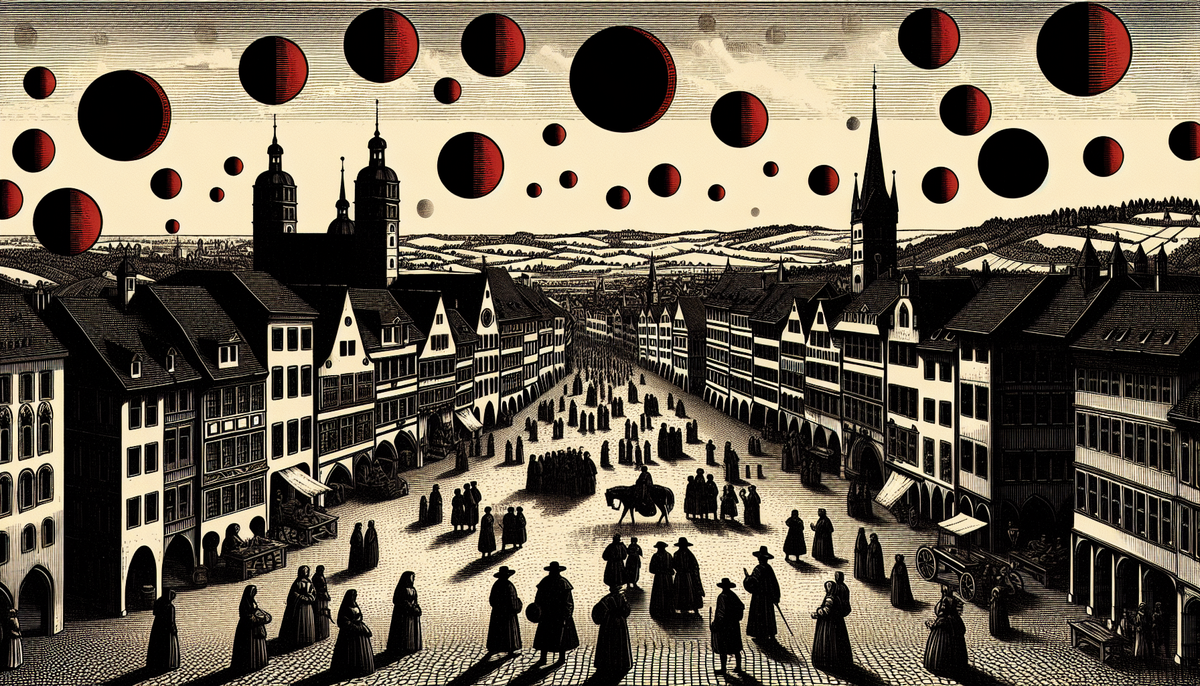
On August 7, 1566, residents of Basel, Switzerland reported observing a mass of black spheres appearing in the sky around the rising sun. The event was documented in a broadsheet produced by Samuel Coccius (also rendered as Samuel Koch), which features an illustration showing numerous dark circular objects surrounding the sun over the Basel cityscape.
The accompanying text, written in Early New High German, describes the spheres appearing at dawn and occupying positions around the sun. The account notes that the phenomenon was observed by many witnesses throughout the city. Like the Nuremberg broadsheet from five years earlier, this document survives in the Wickiana Collection at the Zentralbibliothek Zürich.
The Basel incident is frequently discussed alongside the Nuremberg 1561 event due to their temporal proximity (five years apart), geographic proximity (both Germanic-speaking regions), similar documentation format (illustrated broadsheets), and thematic overlap (mass aerial phenomena at dawn). Both primary documents survive, enabling direct examination and comparison.
Historical Context
Basel in 1566 was a major Swiss city and important center of printing and scholarship. The city had joined the Swiss Confederation in 1501 and had adopted Protestant reforms. Like Nuremberg, Basel had a sophisticated urban population accustomed to printed news media.
The production of broadsheets documenting unusual phenomena was common throughout the Germanic-speaking lands during the 16th century. These served both as news media and moral commentary, with celestial events typically interpreted as divine warnings. The Wickiana Collection, compiled by Johann Jakob Wick (1522-1588), specifically gathered such prodigy reports from across Europe, providing modern researchers with a valuable archive of contemporary documentation.
Event Timeline
Witness Accounts
"Many large black globes were seen in the air, moving before the sun with great swiftness, and turning against each other as if fighting."
Physical Evidence
Competing Explanations
Solar atmospheric phenomenon (sunspots, parhelia, coronae) [3][4]
The timing at dawn and position around the sun is consistent with solar optical phenomena. Sunspots during the 1566 period could appear as dark spheres. Coronae and other solar effects could create circular patterns.
The numerous discrete spheres depicted do not match typical sunspot or parhelion appearance. The description emphasizes multiple distinct objects rather than continuous optical effect. Comparison with Nuremberg suggests different type of phenomenon.
Unexplained aerial objects [4]
The detailed depiction shows distinct circular objects. Multiple witnesses observed discrete spheres. The phenomenon persisted long enough for extended observation.
No physical evidence recovered. Interpretation filtered through 16th century conceptual frameworks. Black color suggests silhouette against sun rather than emitting objects.
Flock of birds silhouetted against sun [4]
Birds flocking at dawn could create circular silhouettes. Dark coloring consistent with backlit objects. Large flocks could produce numerous apparent spheres.
Broadsheet text describes spheres specifically, not birds. Duration and positioning do not match bird behavior. Contemporary observers would likely recognize bird flocks.
Mass psychological/religious phenomenon [3]
The period expected divine signs. News of Nuremberg event may have primed expectations. Religious interpretive framework dominated response.
The detailed visual record suggests observational basis. Coccius separated description from interpretation. Similar documentation to Nuremberg suggests pattern rather than single event.