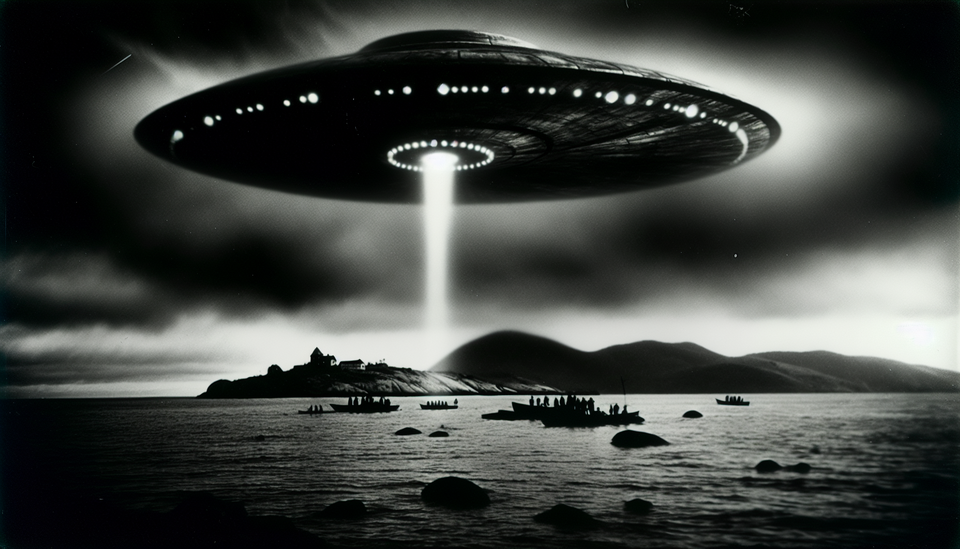
Alexander the Great 329 BC Flying Shields
Ancient accounts describe Alexander's army observing "flying shields" or "great shining silvery shields" in the sky during military campaigns, with some versions claiming the objects affected enemy fortifications.

Multiple ancient and medieval sources describe unusual aerial phenomena witnessed by the army of Alexander the Great during his military campaigns in the 4th century BC. The most commonly cited account describes "great silver shields" or "flying shields" appearing in the sky, with some versions associating these objects with specific military events.
The primary accounts vary significantly in detail and dating. One tradition places the incident during the siege of Tyre in 332 BC, where shining objects allegedly appeared before a section of the city walls collapsed. Another tradition locates the sighting during the Bactrian campaign around 329 BC, describing five shield-like objects that "dove repeatedly" at the army, causing panic among elephants and horses.
The provenance of these accounts is problematic. The earliest surviving references appear in medieval texts citing lost classical sources. Modern researchers including Jacques Vallée have catalogued these accounts while noting that direct primary source verification is impossible. The accounts illustrate recurrent themes in ancient anomaly reports: metallic appearance, shield-like shape, and association with significant historical events.
Historical Context
Alexander III of Macedon (356-323 BC) conquered an empire stretching from Greece to India in just thirteen years. His campaigns were documented by court historians including Callisthenes, though most original accounts were lost. Surviving information comes from later compilations by Arrian, Plutarch, Diodorus Siculus, and Curtius Rufus, written centuries after the events.
Ancient armies routinely reported omens and portents. Celestial phenomena were interpreted as divine messages regarding military outcomes. This cultural context makes it difficult to separate observational accounts from religiously-motivated interpretations. Shield imagery held particular significance in Greek and Macedonian military culture, making "flying shields" a culturally resonant description for any unusual aerial observation.
Event Timeline
Witness Accounts
"[Described observing] great shining silvery shields, spitting fire around the rims... flew over the battle array."
Competing Explanations
Observation of genuine unexplained aerial phenomena [2][3]
Multiple independent traditions preserve accounts. The "shield" shape is consistent across sources. The described behavior (diving, hovering) suggests controlled movement.
No surviving primary sources. Accounts filtered through centuries of copying and potential embellishment. Shield imagery may reflect cultural expectations rather than observation.
Atmospheric or celestial phenomena (sundogs, meteors, ball lightning) [3]
Ancient observers would lack vocabulary for natural atmospheric phenomena. Sundogs can produce bright, shield-like shapes. Meteor swarms could appear as multiple objects.
The described behavior (repeated diving) does not match known natural phenomena. Multiple objects acting in coordination suggests structured observation rather than natural event.
Military propaganda or symbolic narrative [3]
Divine portents supporting Alexander were standard in ancient historiography. Associating celestial intervention with military victory enhanced legitimacy. Greek tradition included divine participation in warfare.
The accounts lack explicit connection to specific gods. The phenomena are described observationally rather than mythologically. Similar accounts appear in non-Alexandrian contexts.
Later medieval interpolation or misattribution [1][3]
No surviving classical text contains the accounts. Medieval scribes sometimes added material to enhance narratives. The specific details vary significantly between versions.
Multiple independent traditions suggest some classical origin. Medieval scribes typically added religious rather than anomalous content. The accounts fit patterns of ancient prodigy reports.